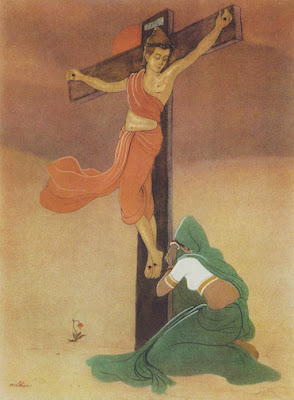
"Pointing out all that I think is wrong with someone else's faith is not the same thing as proclaiming the Gospel."
For a few minutes, let me reflect a bit about the context from which this statement arose. Some of you have been praying along with us during the past couple weeks for a family that has been dealing with a particularly tragic and shocking death. The family is Bhutanese-Nepali and from a Hindu traditional background. I have quite a close relationship to the whole clan and am considered to be a relative in numerous ways (a subject for another time). Thus, during the past couple weeks, I have been with the family members every day offering help, prayer, and love -- and observing some very interesting things.
There is a whole back-story about how things developed and the decisions the family has made during the past couple weeks, but I will not get into all of that. Suffice it to say, most of the family members opted to employ a Nepali (Hindu) priest to come and perform a series of ceremonies over a 12-day period designed to (theologically speaking, or rather thaumaturgically or even pneumatologically speaking - the latter with an intentional small "p") benefit the departed soul (see chapter 5 of my book
Ethnographic Chicago for a good discussion of folk Hindu understandings of departed spirits). The Christ-followers among the relatives struggled during the period of mourning to know how to properly participate. Their perspectives ranged from radical separation -- the desire to depart wholly from all so-called "Hindu" rituals (e.g. fasting from salt and meat, observing the period of mourning, being sad, etc.) -- on the one hand to a much healthier identification. A moment on each of these now:
1. Radical Separation -- from this perspective, it is important for the "Christian" to remove themselves from the Hindus and the Hindu "system" during the period of mourning. Instead, they want to practice the "Christian System". According to the separatists, fasting from salt is decidedly antithetical to being a "pure Christian". Likewise, observing 12 or 13 days of mourning is bad because that is in accordance with the "Hindu system". They proclaim that the Christian system observes only three days of mourning and no fasting. Moreover, it isn't mourning so much as it is gathering together to pray, listen to preaching, sing hymns, and eat snacks. A guiding value for the adherents of this system is that ceremonies, rituals and forms are to be discarded solely on the basis of them being practiced by Hindus and not actually for any clear theological rationale. When asked why a follower of Christ shouldn't do a certain thing, the most common answer is simply, "Because that is a part of the Hindu system".
Distinctives in the "Christian System"
I was able to observe elements of the Separatist praxis during the past couple weeks and have come to the preliminary conclusion that what is distinctive about this so-called "Christian System" does not actually have very much to do with either the Spirit of Jesus Christ or a careful engagement with and appropriation of His Scriptures. The chief distinctions are as follows:
(a) this system emphasizes the importance of doing something different than what the Hindus do and essentially doing it in a place that is separate from where they are doing their things. Also (b) this system employs ceremonies and rituals that are basically Western in origin and indistinguishable from the forms and rituals employed during their normal weekly worship gatherings. Finally, it is (c) decidedly simpler and easier on the practitioners who do not have to fast at all and are finished with their obligations after only a few days.
Similarities between the "Hindu" and "Christian" Systems
Otherwise, I have not found the customs of what these Bhutanese-Nepalis refer to as the "Christian System" to be altogether different from what I have observed the Hindus practicing during the same period. Theologically, there is not a genuinely different foundation upon which they are based. Listening to two sermons last week (one by a Christian pastor and one by a Hindu priest) revealed that at least for these two men (admittedly a small sampling) the central message of their systems was the same. That is, "bad people go to hell" (called "hell" by the Christian and "the way of death" by the Hindu) and "good people go to heaven" (same word used by both). Both men illustrated and defended this principle with very similar stories and rationale. What is more, both seemed to be motivated to perform their respective rituals primarily in order to (a) comfort the family of the deceased and (b) comfort the soul of the departed. I will say that the Christians had less of an emphasis on comforting the soul of the departed, but it was present and there seemed a clear belief among them that the performance of rituals that accorded to the "Christian System" would result in certain (albeit somewhat ineffable) benefits. For that matter, the Christians did not appear to be less fearful about evil spirits or more confident about how to deal with them. Ritually and symbolically, the Christians were less elaborate and less concerned about punctuality, cleanliness, and attentiveness. However, both seemed equally concerned about "orthopraxy". The Hindus and the Christians alike wanted to know what they had to do and practically no room was given for the exercise of spiritual freedom. Also, both parties made use of idols (the Christians erected a nativity scene especially during the period; the Hindus made symbolic idols from khoos grass to represent several deities).
Let me add a note that while the Christians seemed concerned with bringing comfort to the soul of the deceased person, some among them nevertheless were quick to issue an injunction against praying for the dead. Clearly there was a good deal of inconsistency in this. This injunction emerges from a response to the popular concept of people being able to affect the condition of the departed soul through the performance of certain prayers, rituals, etc. Correction in this area seems to be consistent with a Biblical worldview, but I am not convinced that a blunt injunction against praying for the dead is an effective way to communicate this.
Preliminary Conclusions Regarding the Separatist Model
In the end, I observe the Separatist ("Christian System") approach to be simplistic, unhelpful and perhaps even syncretistic. The model is extremely effective for bringing about a change of loyalties from the "Hindu Community" to the "Christian Community" but its value for Jesus-centered discipleship is questionable at best. I do not observe in it that individuals are consequently better educated in Biblical theology nor do I see that from it emerges a greater degree of love, generosity, and sacrificial service towards the mourning family (especially if this family is Hindu).
What is more, since the various Hindu traditions, rituals, customs, etc. each serve important psycho-social functions for the grieving family and surrounding community (e.g. facilitating closure and healthy mourning, encouraging community involvement and need-meeting, etc.) there is a vital and too-often unasked question regarding how effectively the "Christian Separatist System" has provided rituals and customs that can serve the same purpose. This isn't the time to discuss liminality in detail, but its value for helping people and communities to cope with transition and tragedy is immense. We must ask whether the "Christian System's" brief, non-mourning and non-fasting program can effectively create the kind of liminality that is necessary for helping a family deal with the loss of a loved one.
Finally, if syncretism is to be understood as a "way of thinking that says by performing or participating in a particular religious ceremony or practice, you can alter the essential human spiritual condition in the same way that Jesus does through his death on the cross, burial, and resurrection from the dead, because they are parallel truths" (Richard Twiss) -- if we understand syncretism in this way, then the Christian separatist model may indeed be guilty of the kind of syncretism that its proponents so often accuse others of engaging in. From a Biblical perspective the unique work of Christ -- the locus of gospel -- is found in His ability to regenerate the one who comes to Jesus in faith and thus to save from sin, shame and Satan through his atoning sacrifice and the power of the Holy Spirit. In this, Christ is uniquely able to re-position (read: re-create) a fallen and sinful human being into a permanent and right relationship with their Creator in which they enjoy communion with Him forever. And this, all of grace and by faith. It is a liberation from our broken condition which cannot be attained by our own personal effort.
But what happens if this central soteriological truth is no longer what we proclaim? What if instead, we proclaim a message like the one I referred to above which essentially says that to attain salvation one must do good things? The "Christian" preacher and his fellow advocates of the separatist model espoused a soteriology which could be summarized as follows: If you belong to the Christian community and you obey the rules thereof, you will go to heaven. If you don't obey the rules or if you don't belong to the community, you are in danger of hell-fire. But, if this is their gospel then it is difficult to assert that they are proclaiming a Christ who is actually offering something unique. Moreover, they seem to be setting up an apparatus (i.e. joining the Christian community and then obeying the community's rules) that offers salvation in a way other than the one that Jesus actually provided (i.e. regeneration by grace through faith). From this perspective, it is difficult to see how the separatist model avoids syncretism.
2. Radical Identification -- Over against the "Christian System's" emphasis on separation, we may instead speak of identification. Of course, this is ultimately modeled for us in the incarnation of Jesus and I will not repeat everything that I have said before about this here. But I was greatly encouraged during this period of mourning to see some followers of Jesus seeking to identify with the mourners. One of these asked me after a few days, "As a follower of Jesus, what must I do during this time?" Here, she was seeking a law and a new set of rituals -- a new orthopraxy that could mark her off from the Hindus. In this, she revealed how strongly influenced she has been by the ideals of the separatists' system. But I encouraged her by strongly challenging her to continue doing what she was doing. Be with the family. Serve them. Observe their needs and meet them. Pray for them while being with them. Grieve with them. Fast with them. Hope with them. Identify with them in this time. Be Jesus to them. Be Jesus with them.
But is this Radical?
Unfortunately, this concept of identification seems too radical in our days. It is radical because it tends to eliminate external, visible signs of separation. This causes a certain amount of fear in our hearts because we have learned a model of "courage" which says that one must stand up in the city square, curse all the idols of that place, and welcome the subsequent stoning. That to be bold for Jesus is to be obnoxious to everyone else. But must I wear a huge cross, change my name to Thomas or Peter, and trade my old holidays for the "Biblical" ones like Christmas and Easter in order to be a genuine follower of Jesus? See, if we seek to identify with the one who mourns during these times, they may think we are Hindus (or Muslims or Buddhists or whatever). They may not even know we are are "Christians". But, if done right, they will know with certainty that we are in Jesus. They will smell Christ all over us. And given the choice, I would rather people know that I have been with Jesus than that I have been with the "Christians."
Ponder this.
Now, getting back to my original twee
t:
"Pointing out all that I think is wrong with someone else's faith is not the same thing as proclaiming the Gospel."
I sat today in the home of the family who had lost the loved one. Now that their period of mourning is complete and having seen me daily during that period, they were delighted to offer me salty food again. We talked and I pondered, "What should I say today to this family about God and the salvation that Christ uniquely offers?" I thought for a moment about going through all the customs that I had observed them performing during the past two weeks and explaining which elements I affirmed and which I felt were antithetical to the truth revealed by Christ. But, God graciously brought a question to my mind, "Is
that the gospel?" Certainly the gospel of Jesus has implications for these matters, but a tedious picking through of all the things they "got wrong" wasn't really going to commend Christ to them. It wouldn't have rung as good news. It wouldn't have smelled right. What would?
As I continued to ponder this, the old man of the house came to me with a plate of food. He set it before me and pressed his hands together, saying, "Namaskar." This was followed by an explanation by him that in giving this food to me he was seeking to "bow down before the Great Lord, God the Father" (Param Prabhu Parmeshwar Pita). I am not entirely sure what to make of this. It didn't seem to require a commentary on my part at the time. My association with the Triune God through Christ is unquestioned by them. Their desire to draw nearer to this God is really still unquestioned by me. At that point, it seemed clear to me that their need for the person of Jesus was not going to be satisfied by a lecture on correct doctrine or praxis. Not that I'm suggesting that a Christ divorced from Biblical truth is either possible or something that we should desire. But there is something undeniably subtle and mysterious at play here.
Perhaps evangelism is less about presenting orthodoxy or orthopraxy and perhaps more about a kind of "ortho-odoratus" -- a correct fragrance. Paul spoke of the "fragrance of the knowledge of Christ" (2 Cor. 2:14) being spread everywhere through us. He said that to some it would be a fragrance unto death (do not read: an annoying fragrance) and to others a fragrance unto life. Admittedly, it is something more difficult to put your finger on than the "four spiritual laws", but I doubt that it is therefore untrue. As I pondered what would be the "right" things to say in order to point this family toward the hope and wholeness of Jesus Christ, the Spirit of God was at work, diffusing a fragrance of Christ through my immediate presence and the broader context of my history with that family so much more articulate and distinct than any sermon or verbal presentation I could have made. This earthen vessel (to mix a little more 2 Corinthians in) sat in their living room radiating something invisible to myself but unmistakable to them. A fragrance betraying a divine presence that simply couldn't be ignored.
Enough.
My few minutes of reflection has now turned into a few hours and I need to land the plane. Let me do so with a few questions:
1. To what extent are followers of Jesus called to proclaim "orthopraxy" (i.e. to "correct" and replace their rituals and customs) to the nations? Do we observe Christ or the Apostles doing this?
2. Is the "radical separation" model described above a legitimate expression of faith in Christ and a valid option for the disciple of Jesus? Or is it essentially antithetical to a worldview that values devotion to and imitation of Jesus as the unique savior of those from every nation who come to him in faith? How "un-gospel-like" does a gospel have to be before it can be legitimately labeled "another gospel"?
3. What is to be preferred? That those without Christ clearly identify you as a Christian but cannot discern the Spirit and fragrance of Jesus in you or rather that they clearly identify you as one who is exclusively devoted to Jesus but are not so sure that you are a "Christian"? Related to that, does the term "Christian" in our days have the same connotative meaning as it did in the first century? If not, what name are we to rejoice in bearing as Peter commanded (1 Peter 4:16)?
4. How can we commend Christ to the people -- share the good news of salvation and freedom through Jesus -- in a way that is fragrant, distinctive, and Spirit-filled? That is, can we articulate definitive principles for "fragrant" evangelism?
Some of what I have offered above reflects some rather blunt and somewhat certain principles of missiology -- that is, ideas about which I am fairly certain. However, today, so much of what I've written reflects areas where I remain unsettled. As I get older, I become less and less unsettled about being unsettled. But, then again, I know I am not home yet. Looking forward to your feedback!