Showing posts with label hindus. Show all posts

Monday

Sraddha (श्रद्धा): Going Mad to Get Him

A scene is described by the well-known Bengali sage, Swami Vivekananda. He asks his listeners to imagine a thief trying to sleep in a room.  He has come to know that in the very next room there is a mass of gold, essentially unguarded.

The Swami asks, "What will be the condition of that thief?"

It doesn't take much imagination for us to guess that the thief will not be getting much sleep at all that night. His mind will be racing with schemes to somehow get at the gold. He will surely not rest until it is his.

The Swami explains his meaning:

"Do you believe that a man could believe in God and not go mad to get Him?  If a man sincerely believes that there is that immense, infinite mine of Bliss, and that It can be reached, would not that man go mad in his struggle to reach it?"

The true devotee cries out, "As the deer pants for streams of water, so my soul pants for You, O God! My soul thirsts for God, for the Living God! When shall I come and appear before God?" (Bhajan 42:1-2)

And this, is the meaning of the ancient Sanskrit term "sraddha" (श्रद्धा) which is often used as the name for memorial ceremonies performed on the anniversaries of the deaths of our loved ones.  It is to have faith in God and to "go mad to get at him", which should be our attitude daily but especially in difficult times (such as the death of a family member).

Sadly, as the sage says, it seems that not "one in twenty millions in this world believes in God".  He is not wrong.  Even the most devout soul will struggle to maintain sraddha/faith.  Even the bhaktis of Prabhu Sri Yeshuji, the Mahamukteshwar, who listened daily to his pravachan and witnessed countless displays of shakti (power), often were said to have only a "little faith".

But even the answer for this dilemma is found in God.  The Ishwarprerita wrote that our moksha (liberation) would come by grace (anugraha) through faith and that this itself was a gift of God.  We do not have the faith that we need to go mad to get God.  It is foreign to us and must be given by Another.  But praise to Sureshwar, the Good God, who will give freely to all who ask.

Today, ask God to give you true "sraddha" so that you can know the joy of salvation and knowing the Living God.  

Thursday

Bridging the Divide between Hindus and Christians

By Guest Special Guest Blogger -- Lachi Adhikari

It is my pleasure to introduce you to a young leader who is developing into a great thinker even as she learns to write in English.  Originally from Bhutan, Lachi spent most of her life living in a refugee camp in Nepal before migrating to the United States in 2009.  She is a devotee of Lord Sri Jesus who lives within the Hindu cultural traditions that she has grown up with and loves.  Also, she is my sister. -- Cody


One time I went to a Nepali church.  I saw a child recite a passage of scripture in front of a large crowd.  She was speaking God’s words, but sometimes she became confused and forgot. Her mom said that this happened because Satan was disturbing her.  When I heard this, I was shocked.  As someone who comes from a Hindu background, I know that most Hindu people think that Christian people often blame Satan for everything.  We Hindus don’t understand this this kind of thinking.  This is an example of the kind of misunderstanding that happens between Hindus and Christians.  Christians who want to share the Gospel* with Hindus must realize that there is much conflict and confusion between these groups.

Hindu people and Christian people have very different cultures.  For example, Hindus and Christians observe different festivals. Hindus celebrate Dashain and Tihar but Christians celebrate Christmas.  They also have different customs.  For example, Christian brides wear white dresses but Hindus always wear red.  Hindus believe you should burn dead bodies while Christians want to bury them in the ground.  Additionally, Hindus criticize Christians for eating pork and beef and Christians criticize Hindus for eating fried goat blood.  Christian people feel that Hindu people dress immodestly by often wearing American-style clothes, gold jewelry, henna tattoos, and more.  Those who want to share Christ with Hindus should avoid criticizing Hindu culture because of its differences and instead watch, learn and even join in as you gain understanding.

Hindus believe that Christians are low caste people.  That means that Christians are considered ethnically inferior.  High caste people will not eat food prepared by people from low castes.  They also believe it is wrong to intermarry.  When a Hindu becomes a Christian, they are often automatically thought to be low caste.  Even if they were born in a high caste, they will lose their caste.  Followers of Jesus should not react to this with anger or hatred.  Instead they should try to respect and love their Hindu neighbors.

Hindus do not like the way Christians communicate the gospel.  This begins with their form of greeting.  Nepali Christians greet each other by saying “Jaya Masih” (victory to the Messiah), but Hindus don’t understand this greeting and don’t use it.  Most Nepalis greet by saying “Namaste” (I honor you).  Furthermore, Hindus often feel that Christians speak in a proud and boastful way when they talk about Jesus.  Christian pastors are sometimes criticized for preaching loudly and shouting.  Also, Hindus feel that Christians speak rudely about Hindus and Hindu customs by calling them “Satan” or “satanic”.  Hindus don’t like to listen to this kind of speech.  When talking about Jesus or the Gospel, Christians should speak humbly and focus on clear and simple stories about Jesus or their own experiences with God.  They should not call Hindus “Satan” or speak rudely about Hindu practices.


Hindus are actually very interested in Jesus and the Gospel message.  However, their attitudes towards Christians often prevent them from listening.  If followers of Jesus will become good cultural learners, show love and respect to Hindus, and practice sharing the Gospel with humility then much of the misunderstanding and conflict will be resolved and they will find many Hindus who are willing to listen to what they have to say. 

[*The term "Gospel" is used here to refer to the central message of the life, death, resurrection, ascension, and second coming of Lord Sri Jesus and how people can obtain fullness of life and salvation through Him.]

Wearing Tika (तिलक) as a Bhakta of Lord Sri Jesus

Photo by pangalactic gargleblaster

If you disobey the Word of God, even though you have stopped wearing tika (तिलक), you have become as one who is not a Bhakta (devotee and disciple) of Lord Sri Jesus.

If those who wear tika (तिलक) keep the requirements of God's Word, will they not be regarded as Bhaktas of Lord Sri Jesus?

The one who wears tika (तिलक) and yet obeys God's Word will condemn you who, even though you stopped wearing tika (तिलक), are a lawbreaker.

A man is not a Bhakta of Lord Sri Jesus if he is only one outwardly, nor is devotion and discipleship merely outward and physical.

No, a man is a Bhakta of Lord Sri Jesus if he is one inwardly; and devotion and discipleship is of the heart, by the Spirit, not by any written code.

Such a man's praise is not from men, but from God.

(Inspired by the argument of Paul the Apostle from Romans 2:25-29)

Monday

People Group Mapping: Religious Centers in Chicagoland

Here at TIBM we are partnering with the International Mission Board, Send Chicago, and others to engage in a major research project seeking to identify all the people groups of Chicagoland.  Our hope is to ultimately provide the Church information about all the diaspora peoples in the metro area through an online database called Peoplegroups.info (scheduled to be re-launched).  I think that a bunch of mission thinkers are becoming increasingly convicted by the fact that the North American church is still suffering from severe "people blindness".

Currently, we are in the beginning phase of our research.  During this time we are collecting what we refer to as "people group indicators".  These essentially are signs which point to the presence of people groups.  One piece of this is to aim at discovering all religious centers in the Chicago area which have a high probability of being associated with diasporas.

We've published the results of our work in a simple, interactive map that you can view on the main TIBM website.

If you are interested in becoming a part of the larger project to map the top 100 MSAs in the United States, please visit USAPeoplegroups.com to find out more.

Wednesday

बिजय दशमि! The Symbols of Dashain


The Symbols of Dashain
     Dashain is a great time for devotees of the Lord Shri Jesus Christ!  This is a wonderful opportunity for us to worship the Holy Spirit. Together with all our Nepali and Bhutanese friends and family, we can use the rich symbols and traditions of Dashain to express our faith, honor our families, and celebrate Nepali culture.  There are many symbols and traditions in Dashain. Two of the most important are called “tika” and “jamera.” Beginning on the day of “Bijaya Dashami” tika and jamera are used to show love and blessing to family and close friends.
     Followers of Jesus should feel confident to use these symbols also. First, all these things were created by God for His glory. Second, the red tika reminds us of the blood of the Lord Shri Jesus that provides our salvation. The rice in the tika reminds us of the seed of faith that we have in Christ. Finally, the jamera reminds us of the Holy Spirit’s work to help us grow.   Together, these symbols provide a powerful reminder of the victory that we have through TriEak Parmeshwar. So, we can say with joy, “Bijaya Dashami!”

दशैंको चिन्नहरू
     दशैं येशु भक्तहरूको लागि एकदम राम्रो समय हो । यो पवित्र आत्मलाई पूजा गर्नुको निम्ती मङ्गल उत्सव् हो सबै नेपाली-भुटानिहरूसंग हामीले दशैंको चिन्न संस्कृतिद्वरा हाम्रा विश्वास प्रमाण् दिनु हाम्रा परीवारलाई मान्नु सकौं   दुइटा ठुलो चिन्नहरू नै टिका जमरा हो । बिजय दशमिदेखी मनिसहरूले परिवार र नजिक साथिहरूलाई टिका-जमरा आशिषको लागि दीन्छन
     येशु भक्तहरूले पनि यी चिन्नहरू प्रयोग गर्नसक्छन् । पैले, त्रीएक परमेश्वरले सबै थोक उहाँका महिमको निम्ती सृष्टि गर्नुभयो । दोस्त्रो, रातो टिकाले प्रभु श्री येशुको रगत हामिलाई सम्झाउछ । यो रगतद्वरा हाम्रो मुक्ती आउँछ । टिकाको चामल विश्वासको बिउजस्तो छ । यो विश्वासको बिउदेखी मुक्ती आउँछ । र, जमराले पवित्र आत्मको काम हामीलाई सम्झाउछ । उहाँले हाम्रा जीवनमा आफ्न फल उब्जाउनुहुन्छ । जम्मा, यी चिन्नहरू हाम्रो परमेश्वरको विजय एकदम शक्तिशाली सम्झौटो हो । साँच्चै, हामीले भन्दछैं, "बिजय दशमि!"

Tuesday

दशैँ प्रार्थना- Tuesday, 10/23/2012 नवमी (Ninth Day) Self-control Day

By A.D. Thomas

पवित्र आत्माको फल संयम हो।
The fruit of the Holy Spirit is self-control.

पर्खाहरू भत्किएको नगरझैँ आत्मसंयम नभएको मानिस हो। (हितोपदेश २५:२८, Proverbs 25:28)

Today, pray especially for Nepali youth to have self-control. Ask God to give you victory over sin and temptation. Fix your mind on TriEak Parmeshwar.

आज, प्रार्थना गर्नुहोस्- प्रभु श्री येशु, म तपाईंमाथि ध्यान गर्छू। मलाई र सबैलाई संयम दिनुहोस् । मेरो पाप क्षामा गर्नुहोस्।

Monday

दशैँ प्रार्थना- Monday, 10/22/2012 अष्टमी (Eighth Day) Gentleness Day


पवित्र आत्माको फल नम्रता हो.
The fruit of the Holy Spirit is gentleness.

तिमीहरूका भित्री हृदयलाई भलो र शान्त आत्माको अविनाशी रत्नले सजाओ, जो परमेश्वरको दृष्टिमा साह्रै मुल्यवान् छ। (१ पत्रुस ३:४, 1 Peter 3:4)

Ask God to give you gentleness and humility so that your relationships with others can be improved.

आज, प्रार्थना गर्नुहोस्-“पिता परमेश्वर, मलाई अरूहरूसंग शक्त र आनन्दित् सम्बन्ध चाहियो । यसकारण हे प्रभु, ममा कमलो हृदय सृजानुहोस। “

Sunday

दशैँ प्रार्थना- Sunday, 10/21/2012 सप्तमी (Seventh Day) Faithfulness Day


पवित्र आत्माको फल बिश्वस्तत हो।
The fruit of the Holy Spirit is faithfulness.

हामी पछि हट्ने र विनाश परिनेहारूमध्येका होइ्नौं, तर विश्वास गरी बचाइएकाहरूमध्येका हौं।
(हिब्रु १०:३९, Hebrews 10:39)

Pray that Nepalis everywhere will put their trust in the Lord Sri Jesus and receive his salvation.

आज, प्रार्थना गर्नुहोस्-“पिता परमेश्वर, सबै नेपाली र भूटानीहरूलाई प्रभु श्री येशुमाथि विश्वस गर्नु दिनुहोस्, ताकी तीनिहरूले तपाईंको मुक्ती प्राप्त गर्छन्।“

Saturday

दशैँ प्रार्थना- Saturday, 10/20/2012 षष्ठी (Sixth Day) Goodness Day


पवित्र आत्माको फल भलाई हो।
The fruit of the Holy Spirit is goodness.

प्रिय हो, खराबिको अनुकरण नगर, तर भलाईको अनुकरण
गर। जसले भलो गर्दछ, त्यो परमेश्वरको हो, जसले खराबी गर्दछ, त्यसले परमेश्वरलाई देखेको छैन।
(३ युहन्ना १:११, 3 John 1:11)

Today, ask God to help you do something good for another person.

आज, प्रार्थना गर्नुहोस्-“पिता परमेश्वर, तपाईंको निम्ती के गरुँ? आज, के राम्रो कुरा मैले अरूहरूको लागि गर्नुपर्छ?“

Friday

दशैँ प्रार्थना- Friday, 10/19/2012 पञ्चमी (Fifth Day) Kindness Day


पवित्र आत्माको फल दया हो।
The fruit of the Holy Spirit is kindness.

प्रभुको सेवक झगड़ालु हुनुहुँदैन,
तर हरेकको लागि दयालु हुनुपर्छ।
 (२ तिमोथी २:२४, 2 Timothy 2:24)

Today, pray that God will bless all Nepalis with hearts full of kindness towards others. Pray that all quarreling will end.

आज, प्रार्थना गर्नुहोस्-“पिता परमेश्वर, तपाईंको आत्मद्वारा सबै नेपालीहरूलाई दयालु हृदयको वरदान दिनुहोस। सबै झगड़ाहरु खतम गर्नुहोस। “

Thursday

दशैंको सत्संग - Dashain Satsang (Join Us Sunday at 2PM)


Join Us on Sunday, October 21th at 2PM
दशैंको सत्संग
Dashain Satsang
सत्संग, पर्सात्, आराधना, भजन
Satsang, prasaath, worship, bhajan-singing
(Food pani hola?)

TriEak Parmeshwar Mandali


दशैँ प्रार्थना- Thursday, 10/18/2012 चतुर्थी (Fourth Day) Patience Day


पवित्र आत्माको फल धैर्य हो।
The fruit of the Holy Spirit is patience.

परमप्रभुको सामुन्ने मौन बस र धैर्यपूर्वक उहाँको प्रतिक्षा गर। (भजनसंग्रह ३७:७, Psalms 37:7)

Sometimes it is difficult to be patient. Pray for God to give you patience at work and school and with other people.

आज, प्रार्थना गर्नुहोस्-“पिता परमेश्वर, कहिले कहिं मेरो धैर्य छैन । सबै समयमा र सबै मानिसहरूसंग मलाई धैर्य दिनुहोस।“

Wednesday

दशैँ प्रार्थना- Wednesday, 10/17/2012 तृतिया (Third Day) Peace Day


पवित्र आत्माको फल शान्ती हो।
The fruit of the Holy Spirit is peace.

अब शान्तिका प्रभु आफैले सब समय, हरतरहले तिमीहरूलाई शान्ती दिऊन्। प्रभु तिमीहरू सबैसँग रहुन्(२ थेसलोनिकी ३:१६, 2 Thessalonians 3:16)

Today, pray that all refugee peoples everywhere will know the peace of the Lord Sri Jesus Christ in difficult times.

आज, प्रार्थना गर्नुहोस्-“पिता परमेश्वर, सबै शरणागतीहरूलाई तिनिहरुका कष्टहरूमा तपाईंको शान्ती दिनुहोस।“

Tuesday

दशैँ प्रार्थना-Tuesday, 10/16/2012 द्वितीया (Second Day) Joy Day


पवित्र आत्माको फल आनन्द हो।
The fruit of the Holy Spirit is joy.

प्रभुमा सधैँ आनन्द गर। म फेरी पनि भन्दछु, आनन्द गर। (फिलिप्पी ४:४, Philippians 4:4)

Today, pray that Nepalis everywhere will know the joy of the Lord Sri Jesus Christ. Pray for families who are in mourning now to experience new joy in the Lord.

आज, प्रार्थना गर्नुहोस्- “पिता परमेश्वर, सबै नेपालीहरुलाई तपाईंको आनन्द दिनुहोस । सबै बिलाप गर्नेहारुलाई सान्त्वना दिनुहोस ।“

Monday

दशैँ प्रार्थना- Monday, 10/15/2012 प्रतिपदा (First Day) Love Day


पवित्र आत्माको फल प्रेम् हो।
The fruit of the Holy Spirit is love.

प्रिय हो, हामी एउटाले अर्कालाई प्रेम गरौं, किनभने प्रेम
 परमेश्वरबाट आउँछ ( युहन्ना :७, 1 John 4:7a)

Today, pray that Nepalis everywhere will know the love of Pita Parmeshwar. Pray also that they will greatly love their friends, neighbors, and family.

आज, प्रार्थना गर्नुहोस्-“पिता परमेश्वर, सबै नेपालीहरुलाई तपाईंको प्रेम दिनुहोस तपाईंको आत्मद्वारा हामिलाई मदत गर्नुहोस्, ताकी हामी हाम्रा साथि, पेरिवार्, छिमेकि हाम्रा शत्रुहरुलाई पनि प्रेम गर्नु सकौं ।“

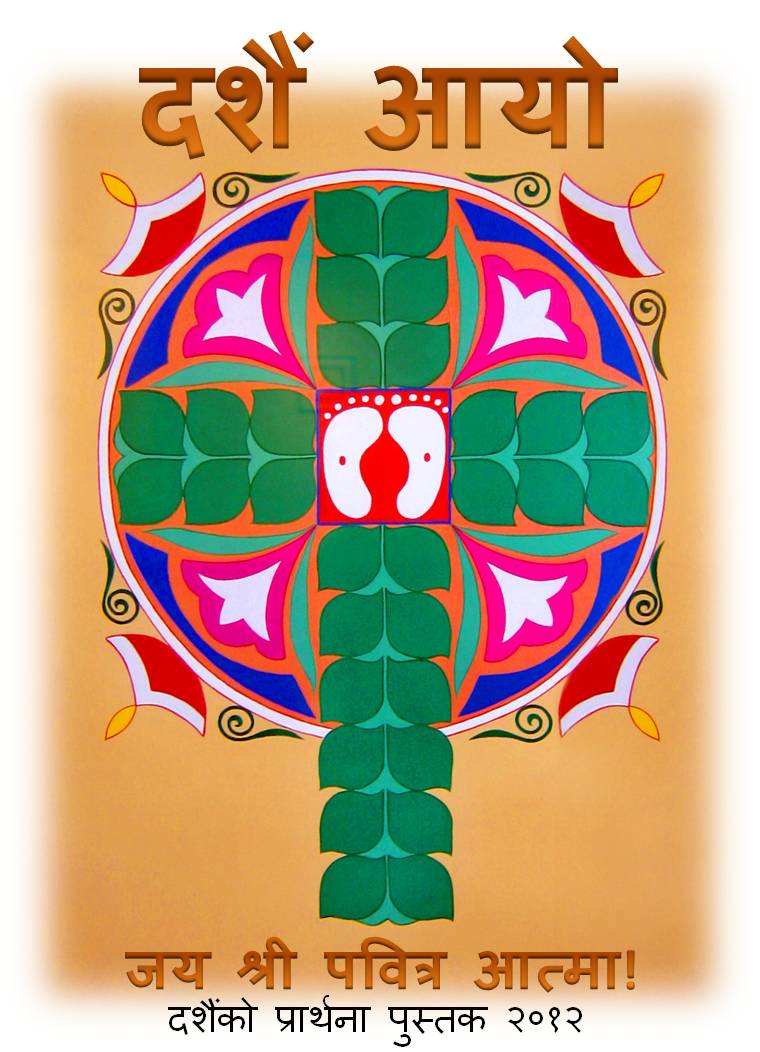
बिजय दशमि! Dashain Aayo! 2012 Dashain Prayer Book Available

"बिजय दशमि!" Today begins the season of Navaratri (नवरात्री), the nine nights leading up to the Nepali Dashain (दशैँ) festival.  During this season, we at TriEak Parmeshwar Mandali like to encourage everyone to enter into a season of prayer especially to ask God to fill our lives with his Holy Spirit (पवित्र आत्मा) and to produce the Spirit's fruit in us.  If you'd like to download a free copy of the 2012 Dashain Prayer Book, for daily guidance on how to pray, you can do that here.  Or simply follow this blog for the next several days for posts on how to pray during this season.

Cover art by Scott Rayl

Sunday

पञ्चमहयजन(Maha Yagna): Five Daily Disciplines for the Devotee of Jesus

By mikaku
What follows is the Nepali version of the "Five Daily Disciplines for Devotees of Jesus"  (पाचवटा  प्रतिदिन् अनुशासन). For the one who has given their life to the Lord Sri Jesus, these yagnas are acts that can be done daily as an expression of devotion (bhakti) and faith (biswas).  I will include below the Nepali and English translation.


पञ्चमहयजन
[Five Great Sacrifices / Disciplines]

१. इश्वर यजन [Discipline of God-worship] 

तपाईंको प्रेम जीवनभन्दा श्रेष्ट छ, यसकारण मेरा ओठले तपाईंको महिमा गर्नेछन. (भजन ६३:३) [Your love is better than life, so my lips with glorify you. (Bhajan 63:3)]

२. शास्त्र यजन [Discipline of Scripture Study]

तपाईंका वचन मेरा गोड़ाका निम्ति बत्ती, र मेरो बाटोको निम्ति उज्यालो हो. (भजन ११९:१०५) [Your word is a lamp for my feet and a light for my path (Bhajan 119:105)]

३. पितृ यजन
[Discipline of Honoring Parents and Elders]

आफ्ना बाबु र आमालाई आदर गर, कि जुन देश तिमीहरुलाई परमप्रभु आफ्ना परमेश्वरले दिनुहुन्छ, त्यहाँ तिमीहरुको आयु लामो होस्. (प्रस्थान २०:१२) [Honor your father and mother, so that you will live long in the country that the Lord your God gives you. (Prasthaan 20:12)]

४. मानुष्य यजन [Discipline of Service to other People]

समस्त व्यवस्था एउटी वचनमा पूरा भएको छ, "तैंले आफ्नो छिमेकीलाई आफूलाई झैँ प्रेम गर्." (गलाती ५:१४) [In one word the entire law is completed, "Love your neighbor just as yourself." (Galaatee 5:14)]

५. सृष्टि यजन [Discipline of Creation Care & Stewardship]

आफ्नो निम्ति पृथ्वीमा धन-सम्पत्ति नथुपर, जहाँ कीरा र खियाले ती नष्ट पार्छन् र जहाँ चोरहरुले गर फोरेर ती चोर्छन्. तर आफ्नो निम्ति स्वर्गमा धन-सम्पत्ति थुपार, जहाँ कीराले वा खियाले नष्ट पार्दैन, र चोरले पनि चोर्दैन. किनकि जहाँ तिम्रो धन हुन्छ, त्यहीँ तिम्रो मन पनि हुन्छ. (मत्ती ६:१९-२१) [Don't keep treasures for yourself on earth where insects and rust can destroy and where thieves can break into your house and steal.  But keep for yourselves treasure in heaven where insects and rust cannot destroy and where thieves do not steal.  For where you treasure is, there your heart will also be. (Mattee 6:19-21)]


At TriEak Parmeshwar Mandali, we have had a fruitful summer of study on these topics during our weekly satsangs.  I recommend utilizing these for the creation of storying sets.  That is, we have found many narratives from the Holy Scriptures that can be used to illustrate and teach the above disciplines.