Showing posts with label Kingdom of God. Show all posts

Friday

Politics will not save us!

I was going to write a long post about the presidential election and my feelings about the candidates.

But, I got tired of it.

These people are both morally corrupt in their thinking and policy making.

There is no savior on the ballot.

Focus on the reign of the King. Spend your energy advancing that.

That's what I'll be doing.

My Mentoring Pattern: Ebenezer, Yahweh Yireh, Kingom Advance

I have become convinced that one of the greatest needs for world mission today is for faithful mentoring of leaders.  Actually, I don't think the big thing is for me to teach others from my vast stores of wisdom.  No.  The stores aren't all that vast.  Rather, I believe that the best way for me to mentor is just to walk alongside someone a
s they pursue the calling of God on their lives.
More and more, I'm finding the fulfillment of my own vision and calling as I stand behind and with other sisters and brothers who are passionate about the Kingdom.

But let me move right into sharing my mentoring pattern.  

The Basic Idea

Essentially, this is all about letting a conversation unfold between myself and the leader I am mentoring.  I really just need to know what God is saying to them and what God is doing in and through them.  Then, I just get involved in that and help amplify that voice.  This literally is accomplished through regular conversations -- about monthly.  During the conversation, we talk and hang out as normal people, pray and may talk about Scripture.  However, the primary focus is on three words:

1. Ebenezer (1 Sam. 7) - I want to know where they are right now.  How far has the Lord brought them?  What can we give thanks for?  And based on all of that, what does immediate obedience look like.  Here is the specific question I ask: 
Based on what you sense the Lord calling you to do and what it will take for you to be obedient to his calling right now, what should you do and what should be accomplished during the next 3-4 months?  (List several specific goals.)
2. Yahweh Yireh (Gen. 22) - I want to know what we should be praying for.  Based on that present sense of calling and what obedience entails, there are definitely some things for which we must pray. Specifcally, I am asking:
As you walk in obedience right now, you are praying for specific fruit to result.  What specific manifestations of the reign of Christ do you expect and hope to see in the next 6 months? 
3. Kingdom Advance (Matthew 11) - Finally, since we are Kingdom people and the Kingdom is advancing always, we can expect tangible expressions of the Kingdom.  So, I want to know what that vision is.  If God answers all our prayers and makes our dreams come true, what would that look like? Here is the question: 
God is developing a vision in your heart as you obey his calling and pray for his Kingdom to come.  What does that vision look like? From where you stand right now, if that vision becomes a reality, what will it look like?
I hope it is obvious that the real power in this pattern is consistency and relationship.  I have attempted something like this before but failed on those two fronts.  But, I believe this can be very adaptable for many kinds of Kingdom workers.  Right now, I am using the pattern for church planters, coffee shop managers, and agricultural workers.

Also, I think knowing your capacity is important.  I'm focusing on the number 12 as a key for me.  I think I can meet monthly with 12 leaders face-to-face.  I think I can add another 12 leaders to meet with remotely (like via WhatsApp or Skype).  

Finally, it is extremely important to me that this is memorable and easy to learn.  I want those I mentor to mentor others who will mentor others.  It's about the Kingdom, so it must be comprehensive.

Wednesday

Brewing a Better World (Part 3): Business ITSELF as Mission

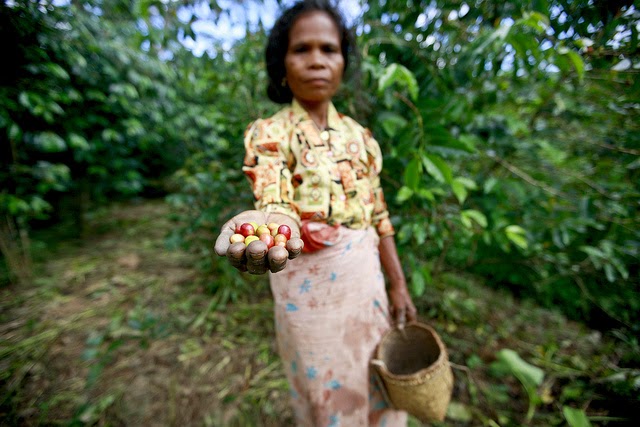
Photo by United Nations Photos
Today it's the third installment of our series about coffee and Jesus and changing the world. By now you have realized that while I am talking about coffee, I'm not just talking about coffee. [Catch up on the whole series here.] The question on my mind today is this:

How can the business of coffee itself transform reality for the sake of the Kingdom of God?

To be honest, I am still doing a lot of research on this, but it seems to be the case that daily earnings of the average coffee grower is significantly less than the price of a single cup of the muck they're mass-pouring over at Starbucks.  The African "coffee belt" countries in particular have long known more than their fair share of poverty, disease, violence, human trafficking and more.  Coffee giants have too often been guilty of ransacking growing areas paying little attention to local wages, pushing low-quality coffee into the market, harming ecosystems (which not only comes at a price measured in flora and fauna but also in long-term agricultural sustainability and thus the livelihoods of people), etc. 

What if we could develop businesses that created jobs and professional development, wealth and sustainability? What if the business found a way to form strategic partnerships to address local and global injustices?  What if we approached agriculture with a passion to steward God's creation?  What if we created third-spaces globally which encouraged redemptive relationships, church-outside-the-walls style engagement with communities, and which otherwise facilitated local disciple-making?  

These "what if"s are sending my brain into overdrive (the caffeine helps) as I consider not just ways to make money but a way to do so that is itself mission.  Not long ago, I was talking with a very wealthy Filipino business man who loves Jesus and missions.  We were talking about coffee and the whole idea of "business as mission".  He drew a very important distinction for me.  "What we are after, Cody, is not just business that supports missions but an entire model of doing business that is itself mission."  That is, we want to create a business that transforms reality for the sake of the Kingdom of Christ.  The implications are very wide for us in the coffee industry because it means thinking about the current realities of the coffee growers, the executives and mariners associated with coffee shipping, the servers and baristas and other employees, our customers and all the many families and communities that we touch.  What are their current realities?  What does God think about those realities?  What is God's will for them and what would it look like to bring the Kingdom fully to bear upon those realities?  

It is actually very exciting.  

Think about a business in your community - perhaps its your own business or workplace.  Ask those same questions:

1. List all the people that your business touches and consider the families and communities surrounding those people.  What is the current reality for them?

2.  What does God think about those realities?  How has sin and Satan established footholds and strongholds in those contexts?  What is God's will?  

3. What would it look like for the Kingdom to come in the context of those realities?  

4. How can you business become mission - an agent of Kingdom transformation - in the context of those realities?

Tuesday

You Can't Just Plant Churches!

Thoughts are formulating in my heart.  


My mission board, which I love, is energized.  Zealous to plant churches.  Hundreds.  Thousands.


I cringe when the well-intentioned talk sounds too much like denominational franchising.  But at the end of the day, that isn't my largest concern.  I am encouraged that people like me (and people far better than me) are intentionally given seats at the table -- even prominent seats.  When my leaders invite my critiques and the critiques of many of my wiser colleagues, I am given hope.   They want the accountability.  They sincerely desire to advance the gospel and not just the Southern Baptist Convention.


So that's good.


But on a deeper level, I am concerned about the passion to just plant churches.  In Chicagoland, the zip code with the highest number of churches per capita is also the one with the highest crime rate.  However you interpret that (i.e. there is more crime there or perhaps there is something wrong with the way the justice system works there), the point is made.  We don't simply need more churches.  We need the Kingdom of God.


So, I have been listening carefully to what my friend, Andrew Jones, has been saying.  He's a hippy who actually lives in a yurt.  So there's that.  And I just saw Titanic for the first time a couple weeks ago, so I have a tendency to feel more comfortable on the anti-bandwagon bandwagon.  So, I don't think I'm reading Andrew because he is cool.  He is cool. And that's kind of intimidating for someone who still thinks that clothing from the eighties is better off left there.


But I digress.  Sorry, haven't blogged since Easter and am still shaking the cobwebs off.


Mission strategies -- even sweeping church planting strategies -- must account for the brokenness of the world.  That is, if the multiplication of churches does not mean the proclamation and demonstration of the gospel as good news where people need it most, then, well, perhaps God won't bless it.


So, a while back, Andrew posted this article about a community of Balinese ex-prostitutes who are finding new life in Christ.  A quote:


Like the young ladies who have been cooking breakfast for us each morning, without complaint. Shining brightly as God's new people. They still have HIV but they are cleaner than anyone around them. They shine. They are new creations. They are the children of God. According tothe Bali Times, one quarter of Bali's 8,800 sex workers are HIV+. The other major HIV+ group in Bali is the businessmen who visit the prostitutes . . . and their wives. Add to that group the HIV+ drug addicts and you have a sizable group of people who need the grace of God.

And I'm just thinking that if our mission strategies don't include that kind of "bringing the Kingdom to bear", then I am not sure they are really from God.  I'm not saying that they will necessarily be from Satan.  They may indeed be derived from insights gleaned from the Bible and good traditions.  But we may not be able to confidently say, "This is what God is saying to us!"


Let's be thinking about it.  More to come.


Friday

By Committee Procedure or By Crucified Prayer

The following struck me as being quite fitting for me just now.  It is from the book Victorious Praying by Alan Redpath.  Enjoy:

     We say, "Thine is the glory," but if we do not get a bit for ourselves, we resign. And we seek to do by committee procedure what can only be done by crucified prayer.  By that I mean praying which turns aside every other concern, and which is so desperate that it refuses to let go until God blesses. 
     The disciples waited and the power came.  We do not wait, and the power does not come.  The disciples witnessed unto Him -- we witness to our program, and the program becomes an awful burden.  We speak to others of our talent and our ability, and we lose the battle.
     It is impossible for me to get alongside you each one personally -- God knows how much I wish I could, but I would urge upon you to wait upon God until you know again His power in your own soul.  I urge upon you to refuse to plan a program until you ask yourself, "Can the world see anything about me to commend Him to others?"
     D.L. Moody was told, "The world has yet to see what God can do through a man fully yielded to Him." And the world has yet to see what God can do through a church or a Christian who refuses to take the glory to themselves.  Oh that God would give us crucified men in the leadership of our churches, in every part of the work, on every committee! May everyone who has a voice of authority be a man who has died to his reputation, a man who is dead to himself, a man who can look up to the Father and say, "Thine is the kingdom -- thine shall be the power; thine shall be the glory."

Tuesday

Concubines, the Kingdom & other interesting topics from the Southern Baptist North Central States Rally

Here I am in Indianapolis for the 2012 North Central States Rally of the Southern Baptist Convention and I don't think I've been around this many white people in years. Nor have I seen sadder looking bartenders.  But, while I am bound by my blogger oath to utilize a fair amount of witty sarcasm, I am actually having a good time and feel pretty encouraged by things.  In some ways, these big SBC meetings are a bit like a family reunion for me.  There are always those things that your "relatives" do that drive you crazy, but overall they kind of endear themselves to you.  Like it or not, these are my people.  Southern Baptists . . . ah, what a funny group we are.  

Anyway, tonight I wanted to share some of the highlights of my day with you and thought I'd do so by means of sharing some of the more interesting one-liners that I heard today.  To protect the innocent/guilty I will withhold the names of those who actually said these things:

1. "There are more scriptures that support you having a concubine than that we should have a Lifeway."

Okay, this was the only time of the day that I actually laughed out loud - hard.  But beyond the humor, this line came in the wider context of a very important and encouraging emphasis.  Tonight the attendees of the rally were presented with a strong call to embrace the work of the Kingdom of God.  I like this very much.  It is, I think, an encouraging sign of strength for Southern Baptists to be talking about the Kingdom of God rather than simply denomination building.  

2. "The new name for the Southern Baptist Convention will not be 'The Particularly Strict Baptist Convention'." 

Nor will it be several other silly things that a group of us guessed as we unsuccessfully sought to pry the top-secret details from our tight-lipped friend who is a member of the task force that has been assigned to research the possibility and viability of changing the long held name of our denomination. What we know is simply that the task force has done their work with much prayer, diligence, and skill and will be presenting a report very soon.  

3. "Hey Cody, is this room your 'Jerusalem'?"

Sometimes I am surprised that people actually pay attention to what I tweet.  This line refers to something I tweeted during the opening session.  Some of you know that I have written on the book of Acts elsewhere and there offered some exegesis of the pericope surrounding Acts 1:8.  It always amazes me to see how deeply this one verse has become ingrained in the mission language of Southern Baptists.  Everyone seems to talk about reaching their "Jerusalem" or their "Samaria".  This, of course, is an application of a particularly symbolic reading of Acts 1:8 that isn't necessarily illegitimate.  However, I think there is a danger in using Acts 1:8 as a metaphor in that it obscures proper exegesis.  There is a tendency for pastors to kind of skim past Acts 1:8 instead of actually exegeting it.  Instead of spending so much time telling people to identify properly their Jerusalem, Judea, and Samaria we should spend more time teaching them to understand what Acts 1:8 means in relationship to 1:7 and 1:9 and so on.  That's all I'm saying.

4.  "Where do all these dots come from?" 

The Send Chicago Coalition met for the second time today to continue to move towards the creation of a comprehensive church planting strategy for Chicagoland.  At one point, I kind of chuckled as I read some of the notes I had been recording.  See, everyone kept talking about representing the particular church planting needs of Chicagoland as "dots on a map".  At one point someone asked honestly, "So, where do all these dots come from?"  It was funny.  There was also a lot of talk about "eating the elephant" and a fair amount of discussion as to whether it was better to eat it one bite at a time or rather that it requires a whole village.  Towards the end, there was even a cake-baking metaphor thrown in.  So, yeah, I'd say we're solidly on track.  No, actually, we kind of are.

Thursday

Parables of the Kingdom (Matthew 13)

A few weeks back, I shared a message from God's Word based on Matthew 13.  That chapter features a collection of parables from the Lord Jesus on the topic of God's Kingdom.  My message was preached to a mostly South Asian audience and translated into Hindi.  So, as I preached, I sought to keep in mind specific worldviews and cultural backgrounds that typify the Indian subcontinent.

Instead of preaching only one or two of these parables, I decided to see them as a collection intended to be understood together.  So, I found myself dividing the parables into two groups.

1. Escatological Parables
2. "Seize the Moment" Parables

Under the first, we have the parable of soils, weeds, the mustard seed, yeast, and the fish in the net.  I classify these as escatological parables because they focus on the culmination of the Kingdom of God.  From taking these together, I derived three principles to share with my audience:

  • God is actively involved.  We don't have to struggle to get God's attention.  We don't have to do something unusual to get Him to notice us.  He is already involved, working, watching, speaking.  
  • Satan is also actively involved (cf. 1 Pet. 5:8).  We ignore this fact to our peril.  If the parables show us that God is working in the world to advance His Kingdom, so they show us an enemy who actively works to hinder it.
  • The end will come.  This world is not a never-ending merry-go-round.  It will end.  Reward and punishment are certain.
I saw the parables of the pearl and treasure are of a different sort.  These parables don't focus on the culmination of the Kingdom, but rather what we are to do now as the Kingdom is proceeding.  And we are to essentially seize it -- to lay hold of it while we still can.  A few straightforward principles flow out of these two parables:
  • We must surrender all unworthy affections.  All lesser pearls but give way to the one of surpassing value.  We must be willing to give away all other things to lay hold of the Kingdom.
  • We must surrender all fears.  I have found that many of those who are not following Christ are hindered by fear.  They fear the criticism and opposition that they will face if they follow Jesus openly.  I can think of people that I know well who are in this situation.  But risk is needed to lay hold of the pearl.  Selling everything you own is risky and invites severe criticism, even opposition.  And what if it all goes wrong.  Surely this is an important point to teach.
  • We must put our trust in God's Son.  This, of course, is what is meant by seizing the Kingdom.
Blessings to you this day!