Showing posts with label coffee. Show all posts

Monday

I Am Not Poor, But My Head Is Poor: A 2017 Report on Endiro Growers Bukalasi


There has been significant coffee news out of Uganda lately.   The Ugandan Coffee Development Authority reported that total exports for the 2016-17 season increased by 18% (https://www.independent.co.ug/ugandas-surging-coffee-exports/).
Another announcement was recently made by the world’s largest furniture retailer, Ikea, who has entered into a multiyear agreement with Ugandan coffee giant Kawacom to put some 500,000 retail bags of coffee on the shelves of their stores around the world (https://dailycoffeenews.com/2017/10/24/ikea-to-begin-selling-coffee-as-part-of-multiyear-uganda-commitment/). 
Such stories were welcomed with excitement by coffee industry players in Uganda, but just how good is this news?
Unfortunately, it is too quickly assumed that increased exports of Ugandan coffee automatically mean good things for the farmers who grow it.  Global coffee trade, however, has long been a demand-side industry in which practically every bean has a buyer somewhere. The farmer who sold all of their coffee last year is not necessarily better off when they sell all of their beans again this year.  Selling out does not necessarily equal economic growth in business and thus cannot be thought to automatically signal positive transformation in the coffee village.
What does?

Transformation of the Coffee Village

Think about it.  A farmer, let’s call her Joyce, who sold 500 kilos of coffee cherries at 1000 Ugandan shillings (UGX) per kilo ($0.27 USD) in the 2013-14 season has made a total of 500,000 UGX or $138 USD.  If demand for Joyce’s coffee increases during the next year she can still only sell a maximum of 100% of her crop.  So, the only way her condition can improve is if she has the means to increase her crop volume or the price at which she sells it. Unfortunately, in Uganda, most farmers don’t have this kind of power.
When we at Endiro began to explore the farm side of coffee a few years ago, we discovered that even the “Fair Trade” farmers were not receiving either fair trade wages or any kind of community inputs which would help them to increase their volumes.  Instead farmers were facing annually decreasing crop yields and were being offered ever-decreasing prices for their coffee.
So, the reality was that a farmer like Joyce from our scenario above reached the 2014-15 season and found that she had only 300 kilos to sell and that the coffee buyers were had decreased their buying price to 900 shillings per kilo. Joyce then earned only 270,000 UGX or $75 USD.  Her hope that coffee could ever improve her quality of life was quickly diminishing.
A recent report by Lehigh University’s Kelly Austin found that the average coffee farming family in Uganda’s coffee-rich Bududa district earns only about $100 USD per year from their crops. Austin goes on to cite increased illnesses, poor education access for children, and gender inequality as just a few side effects of this extreme poverty. (FULL REPORT)
Facilitating change is, at one level, quite simple. If coffee is going to become a source of hope and positive transformation, two things must happen.  First, farmers must get better prices for their coffee and, second, they must achieve better crop yields.

Bukalasi as we found it

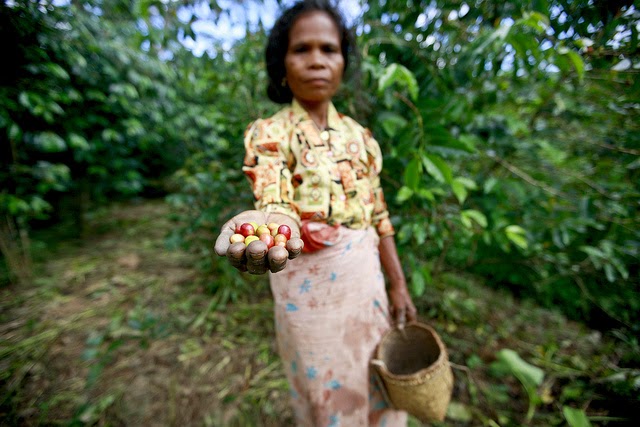
Endiro has been dedicated to pursuing these two things since 2015.  We began our work in the Bududa’s  Bukalasi community with a group of women and men who had been exploited for many years.  These were farmers who were producing coffee that ultimately made it to the shelves of grocery stores in the USA and Europe in packages stamped with a “Fair Trade Certified” label.  Their reality however was far from fair.  The Bukalasi women were selling their ever-decreasing volumes of coffee to middlemen as cherries for 800-1500 UGX per kilo.  The middlemen then resold the coffee to cooperatives and brokers who then continued to move the coffee through several layers of trade on its way to Third Wave coffee joints and high-end grocery stores in the West. No money made it back to Bukalasi in the form of trainings, equipment, or community development projects.  The farmers were left to struggle alone against drought, pests, sickness and more. After  all, if they failed to produce, there was always another farmer somewhere else who had coffee to sell.

Endiro Growers Bukalasi Women’s Group

There is little question that we at Endiro had almost no idea what we were doing when we first began to partner with the ladies of Bukalasi.  We had never farmed coffee and had almost zero agricultural knowledge.  What we did have was a passionate and uncompromising commitment to a few key principles:
1) Ignoring global market prices, we would pay 8,000 UGX per kilo of coffee, without exception.  
2) We would train and equip the farmers so that they could perform initial processing (floating, pulping, washing, drying) so that we could achieve a specialty grade coffee.
3) We would do everything in the context of genuine relationship.
The farmers didn’t believe we were serious at first.  After all, no one was paying that much for coffee.  No one was paying anything close to that.  We were surely deceiving them.  So, at first, they protected themselves.  They used our equipment and continued to sell most of their coffee to the middlemen. When we came for the first portion of the harvest in 2015, we found only a little more than a ton of coffee.  But then the money started to be distributed and the farmers realized that we were for real.  We finished that season (2015-16) with just under 7,000 kilos of coffee.
Now, remember Joyce, our imagined farmer from above.  If she sold us her 300 kilos of coffee that year, she just made 2.4 million shillings ($650 USD). That’s significant.
During the offseason, we continued to coach, pray with and work alongside farmers to re-strategize their farming methods. By teaching them basics of harvesting, pruning, teamwork, how to create natural organic fertilizers and how to control pests through organic methods we saw that the farmers increased their yields for the 2016-17 by over 100%.  We bought over 14,000 kilos from Bukalasi last season and the resulting quality has been judged by many to be Uganda’s best tasting coffee. In fact that Bukalasi coffee is now being enjoyed as far away as the USA and Taiwan.
Once again, we check in with Joyce, our representative farmer.  Now, her crop has increased from 300 kilos to 600.  Joyce now has an annual income on par with the Ugandan national average, something she had never dreamed possible.
During a recent visit to Bukalasi to launch the new season, we heard from all of the Bukalasi team leaders – farmers elected by their peers to represent teams of 50 farmers.  Their testimonies were breathtaking.  One woman said that it was the first time in her life that she had ever seen 1 million shillings.  She was immediately followed by another farmer who said it was her first time to see 2 million!  Several farmers reported that they used their money from last year to buy milk cows and that as a result their children were no longer suffering from malnourishment. Many farmers used their earnings to pay school fees for their children who were no longer missing school.  A young man reported with pride that he had begun nursing school thanks to the family’s coffee earnings.  One can only imagine the long-term impact that an educated younger generation will have on Bukalasi.  The reports continued for a long time.
For the 2017-18 season, Bukalasi has set a goal of 50,000 kilos of coffee and so far they are well on pace.  Preliminary testing suggests that the coffee this year will be the best they’ve ever produced, approaching cupping scores in the high 80s.  Some of our farmers will produce 1000, 2000, 3000 and greater volumes of coffee this year and find themselves quickly approaching the ranks of Uganda’s middle class.
For our part, we have stepped up our commitment to these farmers.  We will be paying 8,300 UGX per kilo this season in Bukalasi and investing in additional equipment, training and more. We are even working to develop coffee leaf tea and cascara (a beverage made from the dried fruit of coffee cherries) so as to bring two additional streams of revenue to the Endiro Growers Bukalasi Group.  
I am not poor, but my head is poor.
This is what we mean when we say we are brewing better together.  We mean partnering with the farming families, who must be fully participating agents in building their own future, to develop holistic strategies which genuinely bring transformation. The ladies of Bukalasi have a saying that they have adopted as a kind of motto for their forward success – “I am not poor, my head is poor.” We believe that these women have much to teach a world of ultra-wealthy coffee conglomerates who cannot see their way to increasing the amount of money they pay farmers. In fact, they have much to teach all of us.  How many of our supposed obstacles are little more than mental blocks.  Maybe we aren’t so poor, but our heads are poor.
We hope you coffee lovers out there will take a moment to consider the choices you make with each cup you drink. We hope you café owners will forget about brand names for a moment when you look for a coffee supplier.  We hope you micro-roasters will look beyond mere certifications and price tags when you order your next bag of green.  Get to know the real story.  And, if you are so inclined, join the Endiro story and brew better together with us (http://www.endirocoffee.com/better-coffee.html)! 

Friday

Getting Ready for Kampala Restaurant Week

Some of you know that a big chunk of my time nowadays is spent working with Endiro Coffee, based in Uganda.  One of my roles is as the Corporate Executive Chef.  It's funny that I find myself cooking again after many years.  I still remember praying at Waffle House that God would allow me to be in full time ministry.  I was convinced that my time as a cook there was being wasted.  But, no ... with the Lord, nothing is wasted.

Anyway, we are getting ready for a big event in Kamapla, Uganda called the Kampala Restaurant Week.  This is a little different than the Kamapala Restaurant Awards that we competed in (and won!) last fall.  The biggest difference is that instead of competing in our own little category ("cafe") we must go head to head against restaurants of many different types.  Also, we are being judged on a three-course meal that we design especially for the event.


So, it fell to me to design the menu.  I'll be heading to Uganda soon to train our chefs to execute the meal perfectly.  Our entry this year embraces two culinary themes that are important to who we are as a company.  The first is, of course, coffee.  Coffee is a powerful symbol of the diversity and beauty of people and cultures throughout the nation and the world.  Also, coffee connects to simple and amazing people in farming villages.  We believe that “with enough coffee, we can change the world” – literally.  So, we are utilizing coffee heavily in this meal through beverage pairings and as an ingredient in cooking.  The second theme is the concept of “glocal food” (global and local).  We believe that Ugandan food is world-class and should interact with world flavors and forms.  This particular meal is an intermingling of Ugandan and Latin cuisine throughout.  The idea of “glocal food” is an invitation and challenge for us to enter into the world of the “other” and to discover the richness of coming together to brew a better world

Here are the courses:

Starter - Carne Asada Crostinis. Served with a Pourover of Bududa Bukalasi Coffee.
“Carne asada” is a marinated, grilled and sliced skirt steak popular in Mexican cuisine.  It is often served as a taco. A “crostini” is an Italian appetizer consisting of toasted bread and any number of toppings.  For our purpose, we are bringing together these two Latin concepts with the subtle Ugandan flavors of mango and pineapple.  The result is a bright, tangy and sweet appetizer that is visually stunning, texturally intriguing and simply delicious.  We are pairing this dish with our Single Origin Bududa Bukalasi prepared as a pourover.  The coffee’s balance of earthiness and acidity complement the smoky steak and fruity flavors of the crostini in a heavenly way.

Entree - Coffee-rubbed Pork Chop Sandwich with Coffee-candied Bacon and Grilled Pineapple. Served with Cold-Brewed Iced Kisoro Coffee.
Here we are taking the concept of a Mexican molé sauce, deconstructing it and rebuilding it as a dry rub.  Anchoring the dry rub is our own single-origin Ugandan coffee from Kisoro. We then take real Ugandan honey and more of that coffee to candy some thick cut bacon.  A generous slice of grilled pineapple brings the bright fruitiness to the party.  Served with hand-cut seasoned fries and a glass of ultra-refreshing cold brewed, iced coffee.  It is a glocal homage to two of our favorite Ugandan tastes – coffee and the Pork Joint!

Dessert - The Aztec Frozen Mocha
I am an amatuer barista at best, so I developed
the basic concept and threw it over to our Head of Coffee for the final development.  Basically, it is a twist on Mexican Hot Chocolate decked out with ice cream, spices and espresso to create the pefect "kiss goodnight" dessert - sweet with a kick.

I have grown to love cooking and how it gives me the opportunity to be creative, to learn, to serve people and to grow in my understanding of people and cultures.  If you are in Kamapala for restaurant week, stop by and try the meal.  If not, maybe I'll cook for you some time.  If you are still wondering how God is going to use you to change the world, hear the Lord say, "What's that in your hand?" (Exodus 4:2)

Wednesday

Brewing a Better World (Part 5): Reversing Coffee's Dark History in a Borderless World

Photo by Craig Sunter
We'll make this the last in the highly-caffeinated 5-part series on coffee, business, and mission in the 21st century that I've entitled, "Brewing a Better World".  [Catch up on the whole series here.]

Today I want to continue my musing upon the idea of coffee as the perfect "Great Commission Commodity".  

Everywhere I go I repeat a simple statement that I believe is absolutely critical for the people of God to digest as they engage in 21st century mission. Here it is:

In the 21st century, people keep moving, especially to the cities and yet stay connected to everywhere.  

This last phrase, about connections, speaks to the reality of globalization in the world today.  A globalized world is a borderless world connected by high-tech communication, high-speed travel, and high-impact influencers whose messages resound from Bollywood to Belfast and from Twitter to Timbuktu (seriously, the city in Mali).  But long before mobile phones outnumbered toilets (a real fact that needs to be addressed, here's a tiny awareness project we did on this) and before Viber made it possible for me to call Uganda from Chicago for free, it was coffee that began to show us that this is indeed a small world after all. Coffee was the first truly global commodity and is the second biggest in the world today (behind oil, which isn't nearly as tasty).  Coffee moves today in ways very similar to the way peoples move and the potential to leverage that movement for the sake of mission is very interesting to me.  As I hop around coffee houses in the US I’m noticing that more and more local roasters are even bypassing “Big Coffee” in favor of direct sourcing strategies – a trend that ties people movement and coffee movement even more closely together.  Again, the key is to leverage movement for mission, which means transforming realities for the sake of Christ  - till all people movement and all coffee movement means gospel movement.

And take this a step further,  if Bosch is right when he says that mission is about transforming reality (and he is right) then the coffee industry has tremendous potential for holistic Kingdom work.  Coffee has a “dark history” (to lift a phrase from Antony Wild) closely tied to slavery, corporate greed and abuse, ecological devastation and worse.  The finest coffees in the world, consumed by the West’s most comfortable suburbanites and grooviest hipsters are nevertheless grown in the poorest regions of the globe by people who are lucky if they make enough money to feed their families. Coffee has not only had a front row seat for some of the greatest injustices in history but the industry as a whole continues to do much to perpetuate the same systemic evils.  

But that’s exactly where things get interesting.  

First of all, coffee shops have always been fertile ground for over-stimulated people to stimulate one another to ideas of innovation, social change, and even revolution (e.g. both the French and American Revolutions were essentially brewed – pun intended – in coffee shops).  I observe today that crowds of caffeinated coffee consumers could still be rallied around coffee production strategies that brought about positive and sustainable transformation. To say nothing of using coffee shops as third-spaces to catalyze all manner of justice causes.

What is more, the business of coffee growing and shipping puts one in close proximity to poverty, disease, violence and the long-term effects of violence, the global gateways of forced migration (trafficking), and other forms of oppression.  Proximity gives way to intentional presence for the Christ-follower, to incarnation and thus to strategic engagement and partnership for the sake of Kingdom transformation.  So, the implications here are deep for how we do business and to what end.  What is clear to me is that the best way to address injustices perpetuated or ignored by the coffee industry is to radically transform the way that business is done. 

So, we close the series today with two quite different concepts - globalization and justice - that will absolutely need to be taken together if we are ever going to end or stop anything.  What does the world look like from your seat?  How are you and your team engaging in global connections and partnerships for the sake of bringing Kingdom justice to bear?  

Well, the coffee shop in which I sitting as I write this is closing.  I need to wrap this up.  I've enjoyed pouring out my heart to you during this series.  Pray for me and for everyone at Trinity and Endiro as we journey with the Lord in this new endeavor.  

Monday

Brewing a Better World (Part 4): The 10/40 Window & The Coffee Belt

Now into part four of this series of musings about how magical beans are going to usher in the millennial reign of Christ . . . well, that's not it exactly, but you know, something big and lofty and mission-y and such . . . I want to begin to muse specifically about the commodity of coffee.  I hereby introduce a phrase sure to take the world by storm, "Great Commission Commodity" and ask:

Is coffee the perfect Great Commission Commodity for 21st century missions?

I will dedicate a couple posts to this question but begin today with a very intriguing image:

Original image by Coffeeforless.com, modified by C. Lorance

Intriguing, isn't it? Or is it just me? 

The "10/40 Window" has long been associated with the world's least reached peoples.  If this is a totally new concept for you, please read up on it at Joshua Project here. Of course, one of the great passions of my life is to travel around and spread the news that God has "opened the window" and scattered unreached peoples from there to everywhere else in the world.  And most of time time when I talk about this, I am addressing people in the West who need to be awakened to the presence of 10/40 Window peoples in their own cities and thereby mobilized to reach out to them with the hope and wholeness of Lord Jesus.  BUT, it is also true that global migration occurs as much on a "South-to-South" trajectory as it does "South-to-North".  What that means is simply that as much as the world's least reached peoples are moving to the great cities of the Western world, they are also moving to Manila, Bolivia, Lima, Accra, Dubai, and Nairobi.  The Kampala skyline is now dotted with many Hindu temples, groups of Arab businessmen can be found in every major airport in Southeast Asia, and Addis Ababa is being rebuilt practically from the ground up by the Chinese. The reverse is also true, East Africans travel down the Nile to North Africa.  Filipinos work as mariners on cargo vessels which travel to every port in the Global South. Girls from Indonesia and India are trafficked into China and elsewhere.  And everyone seems to eventually pass through Dubai.

The phenomenon of South-to-South migration is an ever-increasing force in the world today that inextricably links the destinies of peoples of the 10/40 Window and those living in the Coffee Belt - the region of the world in which all coffee is grown. This geographic juxtaposition means, among other things, that the unreached billions in the Window have close, regular, normal commerce with scores of potential lay-missionaries living in the Belt. 

If we have come to embrace the notion that we now live in the era of missions from everywhere to everywhere (and I know that many in my country have not embraced this) then we must begin expecting and planning for the raising up of countless missionaries from the majority world.  Indeed this is already happening on a large, albeit difficult-to-measure scale.  The Coffee Belt is home to most of these would-be missionaries as it passes through the most populated portions of Latin America, Africa and Asia.  Here is a major "what if":

What if we found a way to pair coffee as a positive, sustainable and profitable business presence with not only evangelism and disciple-making but full-on mission mobilization?  

This is what I mean by musing and pushing yourself to the "what if" questions.  I don't know what those questions are for you and your mission context.  I can only tell you where they are - further.  And I can tell you that the Holy Spirit is waiting for you there.

Wednesday

Brewing a Better World (Part 3): Business ITSELF as Mission

Photo by United Nations Photos
Today it's the third installment of our series about coffee and Jesus and changing the world. By now you have realized that while I am talking about coffee, I'm not just talking about coffee. [Catch up on the whole series here.] The question on my mind today is this:

How can the business of coffee itself transform reality for the sake of the Kingdom of God?

To be honest, I am still doing a lot of research on this, but it seems to be the case that daily earnings of the average coffee grower is significantly less than the price of a single cup of the muck they're mass-pouring over at Starbucks.  The African "coffee belt" countries in particular have long known more than their fair share of poverty, disease, violence, human trafficking and more.  Coffee giants have too often been guilty of ransacking growing areas paying little attention to local wages, pushing low-quality coffee into the market, harming ecosystems (which not only comes at a price measured in flora and fauna but also in long-term agricultural sustainability and thus the livelihoods of people), etc. 

What if we could develop businesses that created jobs and professional development, wealth and sustainability? What if the business found a way to form strategic partnerships to address local and global injustices?  What if we approached agriculture with a passion to steward God's creation?  What if we created third-spaces globally which encouraged redemptive relationships, church-outside-the-walls style engagement with communities, and which otherwise facilitated local disciple-making?  

These "what if"s are sending my brain into overdrive (the caffeine helps) as I consider not just ways to make money but a way to do so that is itself mission.  Not long ago, I was talking with a very wealthy Filipino business man who loves Jesus and missions.  We were talking about coffee and the whole idea of "business as mission".  He drew a very important distinction for me.  "What we are after, Cody, is not just business that supports missions but an entire model of doing business that is itself mission."  That is, we want to create a business that transforms reality for the sake of the Kingdom of Christ.  The implications are very wide for us in the coffee industry because it means thinking about the current realities of the coffee growers, the executives and mariners associated with coffee shipping, the servers and baristas and other employees, our customers and all the many families and communities that we touch.  What are their current realities?  What does God think about those realities?  What is God's will for them and what would it look like to bring the Kingdom fully to bear upon those realities?  

It is actually very exciting.  

Think about a business in your community - perhaps its your own business or workplace.  Ask those same questions:

1. List all the people that your business touches and consider the families and communities surrounding those people.  What is the current reality for them?

2.  What does God think about those realities?  How has sin and Satan established footholds and strongholds in those contexts?  What is God's will?  

3. What would it look like for the Kingdom to come in the context of those realities?  

4. How can you business become mission - an agent of Kingdom transformation - in the context of those realities?

Monday

Brewing a Better World (Part 2): Financial Engines for World Mission

Photo by Asian Development Bank
Let's pick up again on our missiological musings of coffee and missions in the 21st century.  [Catch up on the whole series here.]

Today I'm pondering whether coffee can become a financial engine for world missions.  

A fact that has increasingly disturbed me as a missionary, missions executive and missiologist is the ever-increasing struggle of simple missionaries to secure financial support for their endeavors.  It seems that more and more of the proverbial pie of missions funding is being consumed by short-term projects and trips conducted by local churches.  Many moons ago, when I was a youth minister, the prospect of taking a youth group on a summer missions trip was considered "cutting edge" and "extreme".  Nowadays, its part of the standard job description for many churches.  I've met people who have been on dozens of mission trips and count it as a sign of their commitment to the Great Commission.  I might even be tempted to agree with them except that I've seen far too many promising long-term missionaries forced to leave the field due to a lack of sufficient funding.  It is very difficult for me to celebrate when I know that a week-long overseas trip by a small group of short-term missionaries could easily fund a year's salary or more for someone who was willing to spend their entire life on the mission field.  As I step down from this particular soapbox let me just say that the Western Church has yet to take seriously our responsibility to teach stewardship alongside mission mobilization.  

Well, as the Nepalis say, "Estay chha" (it's like that). I don't see it changing soon and I am very tired of waiting for rich, wasteful Christians to condescend to support people that are sacrificing so much every day for the cause of Christ.  If they are determined to spend more on coffee than on world mission - and they totally are - then I think it's time to get missions into the value chain.  

Simply put, I am determined to see our venture into the coffee industry become extraordinarily profitable for the sake of mission.  It feels odd to even say it, but I want to make lots of money so that I can pump lots of money into missions.  I dream of funding ridiculous projects that bring lasting change and supporting crazy, wild-eyed missionaries who are ready to do whatever would be the modern equivalent of packing their belongings in coffins on their way to the ends of the earth.  Beyond that, I find myself musing about other business ideas too because I'm tired of limping along dependent upon the charity of people who could afford to give in seriously game-changing ways but who simply can't be bothered.  

I'm sorry if I seem upset.  The truth is, Katherine and I have enjoyed the generosity of a very small handful of supporters for years now.  But many of our supporters have been elderly saints who believed in a "pray, give, go" paradigm of mission mobilization rather than the newer "take, spend, and tour" mentality that seems to dominate the stage today.  As these surrogate grandmothers and grandfathers have gone to be with the Lord, they have not been replaced by a younger generation of supporters.  And we are not the only ones who have experienced this.  

I fully believe that the best thing is for most followers of Jesus to be in the workforce and to sacrificially give as they pray for the minority who are called into missions as a career.   I pray that we will experience a global renewal of that very biblical model (Paul did NOT make tents everywhere he went!) but until then, I'm challenging the brothers and sisters that I work with, mentor and oversee to seek sustainable sources of income which will not only provide for their personal needs but actually create significant streams of funding which they can direct towards strategic mission.  

It was an eye-opening moment when I finally came to terms with the fact that I and the folks that I have been working with for years are men and women who are highly skilled, creative thinkers, gifted entrepreneurs and hard workers who have the potential to create and run businesses that were holy, excellent and highly-profitable.  And if I was sitting across the table from you right now, I think we'd talk about the untapped value that God has put into you.  You have skills and expertise that could be used to generate the income that your family needs.  There are ideas that could result in funding streams which could transform the community to which God has called you. To return to an earlier metaphor, I'm just saying that you can wait around and beg for those who should be sharing their pie with you to actually do so OR you can go make your own pie.

Wednesday

Brewing a Better World (Part 1): Musings and Mission and Transforming the World

Photo by Jake Liefer
I remain obsessed with bringing the hope and wholeness of Lord Jesus to those who have been the least-reached by his message, least-reachable by his followers, and least in reach of his reign in this world.  This obsession has manifest itself in many strange ways over the years. I have become strange, and I'm okay with that.

[Read the whole Brewing a Better World Series here.]

Coffee is the latest, perhaps most surprising, new dimension of my strangeness as I try to discover new ways of . . . not sure what exactly.  Bosch said mission is about transforming reality.  That's true and that's what I care about.  That's the passion to which I've devoted the last 18 years of my life.  I have gradually discovered about myself that when I see problems of lostness, brokenness, oppression, injustice and the like I don't want to raise awareness about them.  I don't want to help out.  I want to change it.  I want to end it.  What is worse, I tend to believe that transformation is wholly possible.  

So, all this to say that I've stepped into a more active and significant role with Endiro Coffee - which my sister founded a few years back and which officially became a part of the Trinity family a couple years after that.  I spend about half my time now thinking about (and drinking) coffee.  I've dusted off and refurbished old creative, marketing and branding skills and am even trying to develop my palate so that can tell you with authority if a certain coffee bean is malty, earthy, fruity, honey-toned, or all of the above. And it's all crazy as heck because I had never even consumed a cup of coffee before I went to Cape Town in 2010 - but this all seems to reek of the Holy Spirit.  Indeed the more I meditate upon coffee and its role in my life as a missions leader (particularly while propped up the magical brown substance) the more I find myself in awe of the potential these mighty little beans have for the Kingdom of God in the 21st century.

So, over the next week or so, I want to muse over coffee and mission and do a lot of "what if"-ing - which I suppose is what muse means.  Here are the questions I'll be pondering:

1. Can coffee become a financial engine for world mission? 

2. Can the business of coffee itself transform reality for the sake of the Kingdom?

3. Is coffee the perfect Great Commission commodity for the 21st century? 

4. How do I put the terms "south-to-south migration", "10/40 Window" and "Coffee belt" into the same sentence and somehow articulate how big and awesome is the potential of this grouping of ideas for the sake of mission? (hee-hee)

5. Can coffee-business based in coffee producing nations be used for the mobilization of missionaries from the Global South?

6. Can coffee business put us on the front line of bringing justice to bear where it is needed most?

7. If I have only 6 questions will I seem like I'm not a very good Baptist?

I want to encourage you to muse also.  About coffee or whatever.  Muse about something.  Especially if you care about God and his Kingdom and its advance in your community and the world - you should definitely muse.  Because when you muse and dream and ask "what if" you join the faithful company of protesting saints and prophets who have from the beginning always been at the forefront of God's ever encroaching reign.  Intentionally think outside the box this week.  If mission is about transforming reality, it may very well begin with transforming your mind.