Showing posts with label Nepal. Show all posts

Wednesday

बिजय दशमि! The Symbols of Dashain


The Symbols of Dashain
     Dashain is a great time for devotees of the Lord Shri Jesus Christ!  This is a wonderful opportunity for us to worship the Holy Spirit. Together with all our Nepali and Bhutanese friends and family, we can use the rich symbols and traditions of Dashain to express our faith, honor our families, and celebrate Nepali culture.  There are many symbols and traditions in Dashain. Two of the most important are called “tika” and “jamera.” Beginning on the day of “Bijaya Dashami” tika and jamera are used to show love and blessing to family and close friends.
     Followers of Jesus should feel confident to use these symbols also. First, all these things were created by God for His glory. Second, the red tika reminds us of the blood of the Lord Shri Jesus that provides our salvation. The rice in the tika reminds us of the seed of faith that we have in Christ. Finally, the jamera reminds us of the Holy Spirit’s work to help us grow.   Together, these symbols provide a powerful reminder of the victory that we have through TriEak Parmeshwar. So, we can say with joy, “Bijaya Dashami!”

दशैंको चिन्नहरू
     दशैं येशु भक्तहरूको लागि एकदम राम्रो समय हो । यो पवित्र आत्मलाई पूजा गर्नुको निम्ती मङ्गल उत्सव् हो सबै नेपाली-भुटानिहरूसंग हामीले दशैंको चिन्न संस्कृतिद्वरा हाम्रा विश्वास प्रमाण् दिनु हाम्रा परीवारलाई मान्नु सकौं   दुइटा ठुलो चिन्नहरू नै टिका जमरा हो । बिजय दशमिदेखी मनिसहरूले परिवार र नजिक साथिहरूलाई टिका-जमरा आशिषको लागि दीन्छन
     येशु भक्तहरूले पनि यी चिन्नहरू प्रयोग गर्नसक्छन् । पैले, त्रीएक परमेश्वरले सबै थोक उहाँका महिमको निम्ती सृष्टि गर्नुभयो । दोस्त्रो, रातो टिकाले प्रभु श्री येशुको रगत हामिलाई सम्झाउछ । यो रगतद्वरा हाम्रो मुक्ती आउँछ । टिकाको चामल विश्वासको बिउजस्तो छ । यो विश्वासको बिउदेखी मुक्ती आउँछ । र, जमराले पवित्र आत्मको काम हामीलाई सम्झाउछ । उहाँले हाम्रा जीवनमा आफ्न फल उब्जाउनुहुन्छ । जम्मा, यी चिन्नहरू हाम्रो परमेश्वरको विजय एकदम शक्तिशाली सम्झौटो हो । साँच्चै, हामीले भन्दछैं, "बिजय दशमि!"

Tuesday

दशैँ प्रार्थना- Tuesday, 10/23/2012 नवमी (Ninth Day) Self-control Day

By A.D. Thomas

पवित्र आत्माको फल संयम हो।
The fruit of the Holy Spirit is self-control.

पर्खाहरू भत्किएको नगरझैँ आत्मसंयम नभएको मानिस हो। (हितोपदेश २५:२८, Proverbs 25:28)

Today, pray especially for Nepali youth to have self-control. Ask God to give you victory over sin and temptation. Fix your mind on TriEak Parmeshwar.

आज, प्रार्थना गर्नुहोस्- प्रभु श्री येशु, म तपाईंमाथि ध्यान गर्छू। मलाई र सबैलाई संयम दिनुहोस् । मेरो पाप क्षामा गर्नुहोस्।

Monday

दशैँ प्रार्थना- Monday, 10/22/2012 अष्टमी (Eighth Day) Gentleness Day


पवित्र आत्माको फल नम्रता हो.
The fruit of the Holy Spirit is gentleness.

तिमीहरूका भित्री हृदयलाई भलो र शान्त आत्माको अविनाशी रत्नले सजाओ, जो परमेश्वरको दृष्टिमा साह्रै मुल्यवान् छ। (१ पत्रुस ३:४, 1 Peter 3:4)

Ask God to give you gentleness and humility so that your relationships with others can be improved.

आज, प्रार्थना गर्नुहोस्-“पिता परमेश्वर, मलाई अरूहरूसंग शक्त र आनन्दित् सम्बन्ध चाहियो । यसकारण हे प्रभु, ममा कमलो हृदय सृजानुहोस। “

Sunday

दशैँ प्रार्थना- Sunday, 10/21/2012 सप्तमी (Seventh Day) Faithfulness Day


पवित्र आत्माको फल बिश्वस्तत हो।
The fruit of the Holy Spirit is faithfulness.

हामी पछि हट्ने र विनाश परिनेहारूमध्येका होइ्नौं, तर विश्वास गरी बचाइएकाहरूमध्येका हौं।
(हिब्रु १०:३९, Hebrews 10:39)

Pray that Nepalis everywhere will put their trust in the Lord Sri Jesus and receive his salvation.

आज, प्रार्थना गर्नुहोस्-“पिता परमेश्वर, सबै नेपाली र भूटानीहरूलाई प्रभु श्री येशुमाथि विश्वस गर्नु दिनुहोस्, ताकी तीनिहरूले तपाईंको मुक्ती प्राप्त गर्छन्।“

Saturday

दशैँ प्रार्थना- Saturday, 10/20/2012 षष्ठी (Sixth Day) Goodness Day


पवित्र आत्माको फल भलाई हो।
The fruit of the Holy Spirit is goodness.

प्रिय हो, खराबिको अनुकरण नगर, तर भलाईको अनुकरण
गर। जसले भलो गर्दछ, त्यो परमेश्वरको हो, जसले खराबी गर्दछ, त्यसले परमेश्वरलाई देखेको छैन।
(३ युहन्ना १:११, 3 John 1:11)

Today, ask God to help you do something good for another person.

आज, प्रार्थना गर्नुहोस्-“पिता परमेश्वर, तपाईंको निम्ती के गरुँ? आज, के राम्रो कुरा मैले अरूहरूको लागि गर्नुपर्छ?“

Friday

दशैँ प्रार्थना- Friday, 10/19/2012 पञ्चमी (Fifth Day) Kindness Day


पवित्र आत्माको फल दया हो।
The fruit of the Holy Spirit is kindness.

प्रभुको सेवक झगड़ालु हुनुहुँदैन,
तर हरेकको लागि दयालु हुनुपर्छ।
 (२ तिमोथी २:२४, 2 Timothy 2:24)

Today, pray that God will bless all Nepalis with hearts full of kindness towards others. Pray that all quarreling will end.

आज, प्रार्थना गर्नुहोस्-“पिता परमेश्वर, तपाईंको आत्मद्वारा सबै नेपालीहरूलाई दयालु हृदयको वरदान दिनुहोस। सबै झगड़ाहरु खतम गर्नुहोस। “

Thursday

दशैंको सत्संग - Dashain Satsang (Join Us Sunday at 2PM)


Join Us on Sunday, October 21th at 2PM
दशैंको सत्संग
Dashain Satsang
सत्संग, पर्सात्, आराधना, भजन
Satsang, prasaath, worship, bhajan-singing
(Food pani hola?)

TriEak Parmeshwar Mandali


दशैँ प्रार्थना- Thursday, 10/18/2012 चतुर्थी (Fourth Day) Patience Day


पवित्र आत्माको फल धैर्य हो।
The fruit of the Holy Spirit is patience.

परमप्रभुको सामुन्ने मौन बस र धैर्यपूर्वक उहाँको प्रतिक्षा गर। (भजनसंग्रह ३७:७, Psalms 37:7)

Sometimes it is difficult to be patient. Pray for God to give you patience at work and school and with other people.

आज, प्रार्थना गर्नुहोस्-“पिता परमेश्वर, कहिले कहिं मेरो धैर्य छैन । सबै समयमा र सबै मानिसहरूसंग मलाई धैर्य दिनुहोस।“

Wednesday

दशैँ प्रार्थना- Wednesday, 10/17/2012 तृतिया (Third Day) Peace Day


पवित्र आत्माको फल शान्ती हो।
The fruit of the Holy Spirit is peace.

अब शान्तिका प्रभु आफैले सब समय, हरतरहले तिमीहरूलाई शान्ती दिऊन्। प्रभु तिमीहरू सबैसँग रहुन्(२ थेसलोनिकी ३:१६, 2 Thessalonians 3:16)

Today, pray that all refugee peoples everywhere will know the peace of the Lord Sri Jesus Christ in difficult times.

आज, प्रार्थना गर्नुहोस्-“पिता परमेश्वर, सबै शरणागतीहरूलाई तिनिहरुका कष्टहरूमा तपाईंको शान्ती दिनुहोस।“

Tuesday

दशैँ प्रार्थना-Tuesday, 10/16/2012 द्वितीया (Second Day) Joy Day


पवित्र आत्माको फल आनन्द हो।
The fruit of the Holy Spirit is joy.

प्रभुमा सधैँ आनन्द गर। म फेरी पनि भन्दछु, आनन्द गर। (फिलिप्पी ४:४, Philippians 4:4)

Today, pray that Nepalis everywhere will know the joy of the Lord Sri Jesus Christ. Pray for families who are in mourning now to experience new joy in the Lord.

आज, प्रार्थना गर्नुहोस्- “पिता परमेश्वर, सबै नेपालीहरुलाई तपाईंको आनन्द दिनुहोस । सबै बिलाप गर्नेहारुलाई सान्त्वना दिनुहोस ।“

Monday

दशैँ प्रार्थना- Monday, 10/15/2012 प्रतिपदा (First Day) Love Day


पवित्र आत्माको फल प्रेम् हो।
The fruit of the Holy Spirit is love.

प्रिय हो, हामी एउटाले अर्कालाई प्रेम गरौं, किनभने प्रेम
 परमेश्वरबाट आउँछ ( युहन्ना :७, 1 John 4:7a)

Today, pray that Nepalis everywhere will know the love of Pita Parmeshwar. Pray also that they will greatly love their friends, neighbors, and family.

आज, प्रार्थना गर्नुहोस्-“पिता परमेश्वर, सबै नेपालीहरुलाई तपाईंको प्रेम दिनुहोस तपाईंको आत्मद्वारा हामिलाई मदत गर्नुहोस्, ताकी हामी हाम्रा साथि, पेरिवार्, छिमेकि हाम्रा शत्रुहरुलाई पनि प्रेम गर्नु सकौं ।“

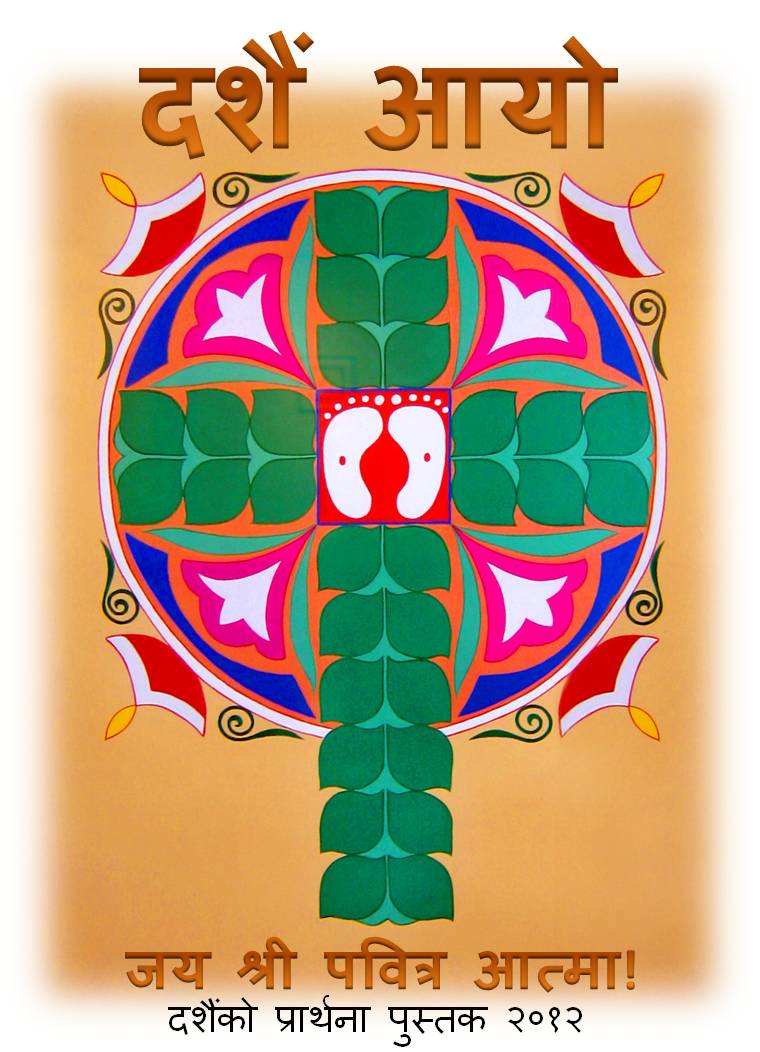
बिजय दशमि! Dashain Aayo! 2012 Dashain Prayer Book Available

"बिजय दशमि!" Today begins the season of Navaratri (नवरात्री), the nine nights leading up to the Nepali Dashain (दशैँ) festival.  During this season, we at TriEak Parmeshwar Mandali like to encourage everyone to enter into a season of prayer especially to ask God to fill our lives with his Holy Spirit (पवित्र आत्मा) and to produce the Spirit's fruit in us.  If you'd like to download a free copy of the 2012 Dashain Prayer Book, for daily guidance on how to pray, you can do that here.  Or simply follow this blog for the next several days for posts on how to pray during this season.

Cover art by Scott Rayl

Sunday

पञ्चमहयजन(Maha Yagna): Five Daily Disciplines for the Devotee of Jesus

By mikaku
What follows is the Nepali version of the "Five Daily Disciplines for Devotees of Jesus"  (पाचवटा  प्रतिदिन् अनुशासन). For the one who has given their life to the Lord Sri Jesus, these yagnas are acts that can be done daily as an expression of devotion (bhakti) and faith (biswas).  I will include below the Nepali and English translation.


पञ्चमहयजन
[Five Great Sacrifices / Disciplines]

१. इश्वर यजन [Discipline of God-worship] 

तपाईंको प्रेम जीवनभन्दा श्रेष्ट छ, यसकारण मेरा ओठले तपाईंको महिमा गर्नेछन. (भजन ६३:३) [Your love is better than life, so my lips with glorify you. (Bhajan 63:3)]

२. शास्त्र यजन [Discipline of Scripture Study]

तपाईंका वचन मेरा गोड़ाका निम्ति बत्ती, र मेरो बाटोको निम्ति उज्यालो हो. (भजन ११९:१०५) [Your word is a lamp for my feet and a light for my path (Bhajan 119:105)]

३. पितृ यजन
[Discipline of Honoring Parents and Elders]

आफ्ना बाबु र आमालाई आदर गर, कि जुन देश तिमीहरुलाई परमप्रभु आफ्ना परमेश्वरले दिनुहुन्छ, त्यहाँ तिमीहरुको आयु लामो होस्. (प्रस्थान २०:१२) [Honor your father and mother, so that you will live long in the country that the Lord your God gives you. (Prasthaan 20:12)]

४. मानुष्य यजन [Discipline of Service to other People]

समस्त व्यवस्था एउटी वचनमा पूरा भएको छ, "तैंले आफ्नो छिमेकीलाई आफूलाई झैँ प्रेम गर्." (गलाती ५:१४) [In one word the entire law is completed, "Love your neighbor just as yourself." (Galaatee 5:14)]

५. सृष्टि यजन [Discipline of Creation Care & Stewardship]

आफ्नो निम्ति पृथ्वीमा धन-सम्पत्ति नथुपर, जहाँ कीरा र खियाले ती नष्ट पार्छन् र जहाँ चोरहरुले गर फोरेर ती चोर्छन्. तर आफ्नो निम्ति स्वर्गमा धन-सम्पत्ति थुपार, जहाँ कीराले वा खियाले नष्ट पार्दैन, र चोरले पनि चोर्दैन. किनकि जहाँ तिम्रो धन हुन्छ, त्यहीँ तिम्रो मन पनि हुन्छ. (मत्ती ६:१९-२१) [Don't keep treasures for yourself on earth where insects and rust can destroy and where thieves can break into your house and steal.  But keep for yourselves treasure in heaven where insects and rust cannot destroy and where thieves do not steal.  For where you treasure is, there your heart will also be. (Mattee 6:19-21)]


At TriEak Parmeshwar Mandali, we have had a fruitful summer of study on these topics during our weekly satsangs.  I recommend utilizing these for the creation of storying sets.  That is, we have found many narratives from the Holy Scriptures that can be used to illustrate and teach the above disciplines.  

Thursday

Hare Jesus, Hare Jesus: Answering a Critic

Recently, a video of mine that was long ago posted on YouTube received a concerned, yet graciously written, comment (BTW- Another visitor to my channel apparently flagged that comment as spam and I want to go on the record as saying that it wasn’t me).  Welcoming the chance to clarify any misunderstanding, I quickly responded.  I have not yet received a follow up, but thought it might be a helpful thing today to share the substance of that exchange here.  First, here is the video in question:


This is called the "TriEak Pameshwar Mahamantra" (i.e. "the great meditative prayer to the Triune God").  It has been adapted from what is called the "Mahamantra" and is especially popular among members of the ISKON or Hare Krishna movement.  The text of what I am saying is as follows:


हरे पिता हरे पिता, पिता पिता हरे हरे
हरे पुत्र हरे पुत्र, पुत्र पुत्र हरे हरे
हरे आत्मा हरे आत्म, आत्मा आत्मा हरे हरे
त्रिएक परमेश्वर हरे हरे,
त्रिएक परमेश्वर हरे हरे । 

Hare Pita Hare Pita, Pita Pita Hare Hare

Hare Putra Hare Putra, Putra Putra Hare Hare
Hare Atma Hare Atma, Atma Atma Hare Hare
TriEak Parmeshwar Hare Hare,
TriEak Parmeshwar Hare Hare.


Which may be translated as:   

Father, remove my sin
Son, remove my sin
Holy Spirit, remove my sin
Triune God, remove my sin.

Now the concern raised by my YouTube viewer seemed focused on the use of the word "Hare" (हरे).  Here is the comment:

Brother, I really admire your heart and effort. But if we are not careful about this kind of contextualization then there will be greater consequences. I do not feel comfortable while contextualization fades power of gospel. The word 'Hare' is Hindu god Bishnu and you are putting Father, Son and Holy Spirit after hindu god Bishnu in your maha mantra.


As I said, a very graciously and kindly written comment.  The above comment (with the exception of the kindly tone, which is sadly rare) is actually a pretty good representation of the kind of opposition that is leveled by Christians against the efforts of other Christians to pursue contextualization.

Vishnu's Name

The commenter's basic mistake is a misunderstanding of the word "hare" (हरे) which he incorrectly identifies as a name for the god Vishnu.  It seems that the commenter has confused the Sanskrit terms "hare" with "hari" (हरि).  The latter is a term which has the basic meaning of yellow, green or "fawn-colored".  It has come to be popularly associated with the gods Vishnu and Krishna  and is sometimes used simply as a proper name in reference to one or the other (or both) of them.  The former (hare) is a variation of the Sanskrit word हर (hara) which means "taking away" or "removing".  Connotative use in prayers by Hindus carries a meaning of "take away my sin" or "take away my evil".   In one Nepali tradition, devotees of "Mahadev" will take a ritual bath while repeating "hara-hara".  In that case, the sense of meaning is clearly "wipe away my sin".  

The popular "mahamantra" prayer contains the refrains, "hare Krishna, hare Krishna, Krishna Krishna, hare hare" and "hare Rama, hare Rama, Rama Rama hare hare".  There also, the meaning is clear.  The word is हरे and should be understood to mean, "Krishna, take away my sin" and "Rama, take away my sin."  It does not mean "Vishnu Krishna" and "Vishnu Rama".  Nor does it mean "Green Krishna" and "Green Rama".  The word is not हरि (hari) but हरे (hare).  One Hare Krishna devotee explains it this way:

"The word hare has come from 'haran' which means 'to take away' or 'to end'.  So when one says 'hare Krishna', he requests the God (the supreme consciousness) to take away his sorrows, his shortcomings, his failures, and pains.  This Hare Krishna Mantra is actually a little prayer to God for taking away all the sorrows, pains and shortcomings of the chanter and provide him bliss and joy."

The above, I hope, illustrates why it is important to seek proper understanding before leveling criticism.  My experience has taught me that followers of Jesus can be very quick to condemn things that they don't understand.  This can have the effect of obscuring the message of Jesus Christ to our listeners.  They may hear us saying something like "Jesus hates you" when that isn't what we meant at all.  Again, we may look to Jesus who didn't hesitate to prophetically critique the societal sin that he saw in his day.  While his opponents sometimes reacted very strongly against him, they never accused him of not understanding.  My commenter is concerned that contextualization sometimes "fades the power of the gospel".  Setting aside for a moment that nothing can actually do that (i.e. fade the power of the gospel), what should be of a bigger concern is whether or not it is actually the gospel that is being communicated.

Billions of Names Off-Limits?

Beyond this, however, I need to highlight another element to my commenter's argument.  There is an unchecked assumption that undergirds his critique that must not be left unexposed.   That is, while we've refuted the notion that "hare" is to be understood as a name for Vishnu, there is still the underlying assumption that any name given to Vishnu by the devotees of Vishnu cannot be used by followers and devotees of Jesus in their worship of the Triune God.  Still further below this is the assumption that no name used by devotees of any other god can be used by the followers of Jesus.  This assumption however, must be rejected outright.

In the first place, my commenter is probably getting his idea of "hari" (again, not "hare") as a name for Vishnu from stanza 69 of the Shri Vishnu Sahasra-Nama Stotram (although he may have arrived at this idea in a very indirect way).  The title of this ancient Sanskrit text can be translated as "The Thousand Names of Vishnu".  Again, stanza 69 features the name "hari" (not "hare", which doesn't appear in the text) as one of the names of Vishnu.  That is, one of a thousand names for Vishnu!  What are some of the other names?  Just to mention a few: paramaatma (supreme spirit), saakshee (witness), prabhu (lord), pavitram (holy one), sharanam (refuge), satyah (truth), guru (teacher), sarva shaktiman (all mighty), and parameshwar (supreme god).  A natural question flowing from my commenter's argument would be "upon what basis do Hindi and Nepali-speaking Christians justify the use any of the above terms in their worship of Jesus Christ?"  These are all "names of Vishnu".  If we accept the premise that any name used in reference to Vishnu cannot be used in reference to Jesus (or the Father, or the Holy Spirit), then we cannot use any of the above names.  Moreover, much of South Asian hymnody, Christian theological literature, and Bible translations would need to be scrapped as they make great use of the above terms.  Once we've then cleaned up the Church from all of these names of Vishnu, we would then have to proceed to the thousand names of Shiva, Lalita, Ganesh, Lakshmi, Durga, and 330 million others.  I highly doubt that we'd be left with any language at all.

No, this assumption must be discarded.  The question is not whether or not a name has been used in reference to another deity.  It is, after all, undeniable that words like Christ, Lord, God, Adoni, El, Theos etc. have all be used in reference to other gods and did not emerge from the mysterious ooze of some primordial Christian "super-culture". The question must be whether or not a particular word can be appropriately used in reference to the Triune God of the Bible.  Is he Master (swami), Lord (prabhu), all-mighty (sarva shaktiman), the light (jyoti), savior (muktidata)? And does he remove sin (hare)? 

To the one who desires to share the hope of the Lord Jesus with the Hindu world, I would ask that you consider the following:

  1. What is your Hindu friend praying?  Do you understand it?
  2. Are they asking for something that they shouldn't desire?  Or is their desire legitimate and commendable (e.g. forgiveness, illumination, eternal life)?
  3. Is part of the "good news" of the gospel the fact that the person and work of Jesus Christ actually offers an answer to that request?

In the case of the traditional "mahamantra", what we have done is simply to let people know that we resonate and empathize with their desire to have their sins and failures removed.  "Hare-hare" is a legitimate prayer to pray.  We then offer both the form and substance of the "TriEak Parmeshwar Mahamantra" -- pointing people to a fulfillment that can be found in Christ.  In response to our "hare-hare", Jesus, by virtue of his atonement on the cross says, "Yes!"  He has accomplished by his blood what countless Hindus pray for daily.  

Blessings!